War Crimes: Mass Execution of Captured FAMa Soldiers Near Tabankort, Gao Region — 18 July 2026
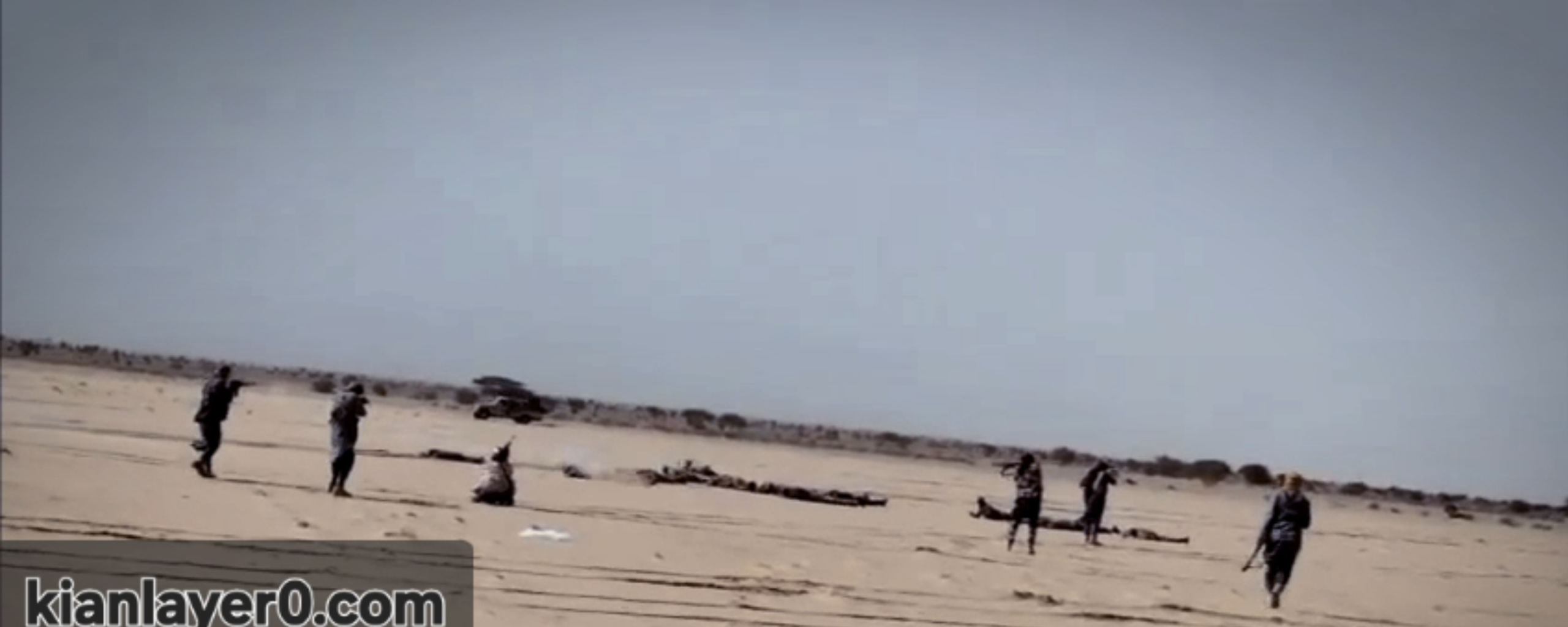
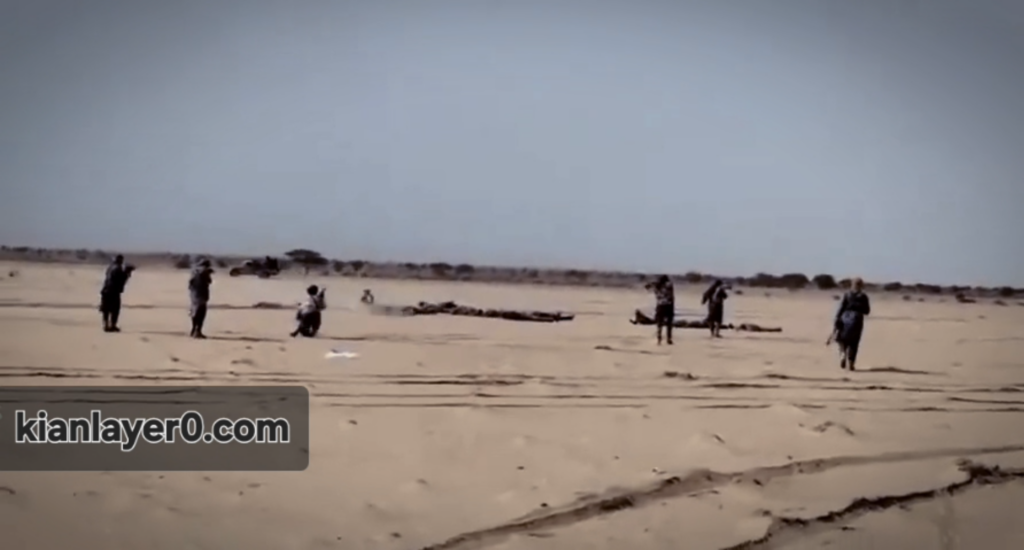
Video 7 — JNIM and FLA footage of the execution of bound Malian Armed Forces prisoners at the primary killing site near Tabankort, 18 July 2026.
On 18 July 2026, fighters of Jama’at Nusrat al-Islam wal-Muslimin and the Azawad Liberation Front ambushed a Malian army convoy near Tabankort, in the Gao region, and captured dozens of soldiers alive. The perpetrators filmed what they did next at every stage: the surrenders, the loading, the transport into open desert, the binding, and the killing at a primary execution site and in clusters along the route. Five days later, the United Nations Human Rights Office publicly demanded a thorough and independent investigation, naming both groups and stating the legal position in one sentence: “Killing, torturing or abusing individuals hors de combat is a war crime.” This article publishes the full video record, numbered as it is held in this archive, reconstructs the timeline of the massacre, and assesses it against the Rome Statute, international humanitarian law, and Islamic law, the framework JNIM claims to implement, and the tradition to which perpetrators and victims alike belong. It is the largest filmed mass execution of captured personnel this archive has documented in the Sahel conflict, and the most extensive single evidentiary release this site has published.
context
The road that produced this massacre had been fought over for two weeks. On 4 July 2026, FLA separatists and JNIM fighters seized the strategic northern town of Anefis as part of a coordinated series of attacks across the country. The Malian army retook the town on 10 July at significant cost approximately 30 soldiers killed and 60 wounded, by the general staff’s own toll of 12 July, and the FLA acknowledged losing some of its best fighters in the battle.
Eight days later, on the morning of Saturday 18 July, a logistics convoy left Anefis for Gao city: fuel tankers, cargo trucks, escort vehicles. It was ambushed near Tabankort, in open desert. A military source in Gao confirmed the ambush to AFP that morning, describing ongoing fighting on the Anefis–Gao axis. The Malian army confirmed in a statement that armed groups had ambushed the convoy of Malian soldiers and their partners. a reference to Russia’s Africa Corps, whose personnel the attacking groups claimed were travelling with the convoy, and announced counterattacks. On Sunday the army said it had struck three enemy positions in the area and that the remainder of the convoy had broken free and continued its route.Eight days later, on the morning of Saturday 18 July, a logistics convoy left Anefis for Gao city: fuel tankers, cargo trucks, escort vehicles. It was ambushed near Tabankort, in open desert. A military source in Gao confirmed the ambush to AFP that morning, describing ongoing fighting on the Anefis–Gao axis. The Malian army confirmed in a statement that armed groups had ambushed the convoy of Malian soldiers and their partners. a reference to Russia’s Africa Corps, whose personnel the attacking groups claimed were travelling with the convoy, and announced counterattacks. On Sunday the army said it had struck three enemy positions in the area and that the remainder of the convoy had broken free and continued its route.
Both organisations claimed the operation as a joint attack, in separate written statements, the same day. The FLA’s spokesperson, Mohamed Elmaouloud Ramadane, said many soldiers had been killed and others captured alive, with army vehicles including armoured cars destroyed or seized intact. The FLA circulated images showing what it said were dozens of captured soldiers. Neither claim was an exaggeration. The footage published below is the proof of both.
Mali country context, Gao region highlighted
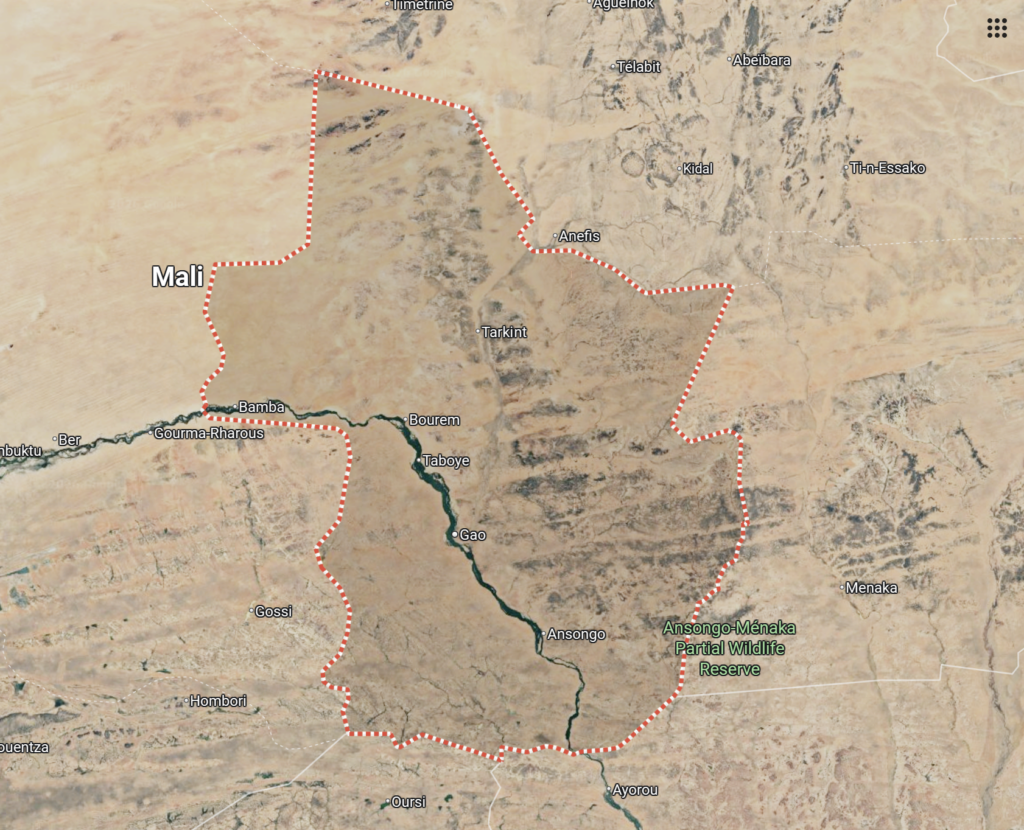
Anefis–Tabankort–Gao axis: showing satellite imagery of the approximation of the route and region of the ambush and execution site not an exact geolocation. Contextual purposes not intelligence.
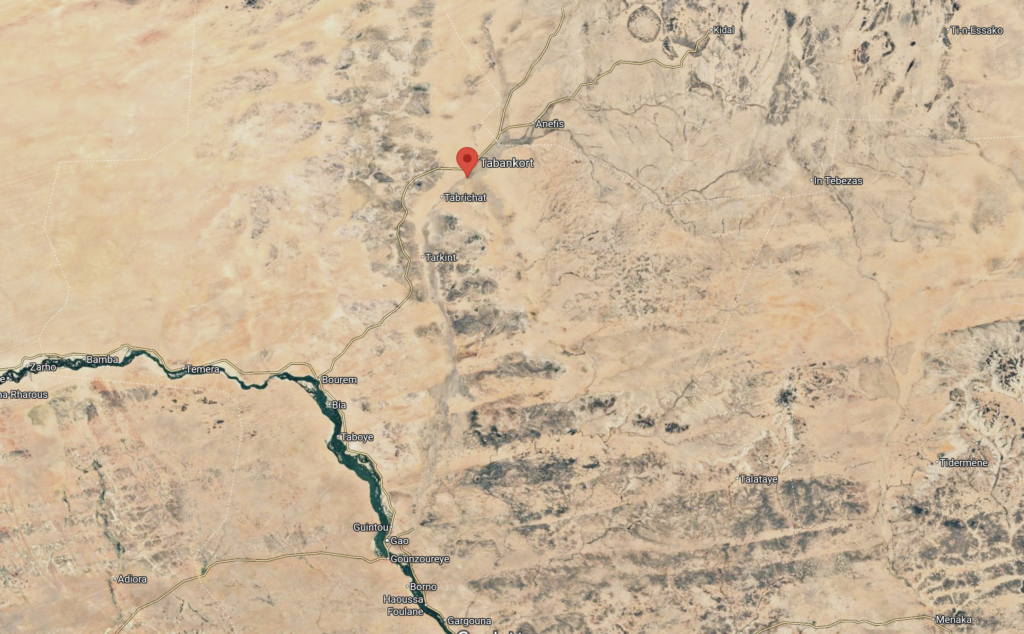
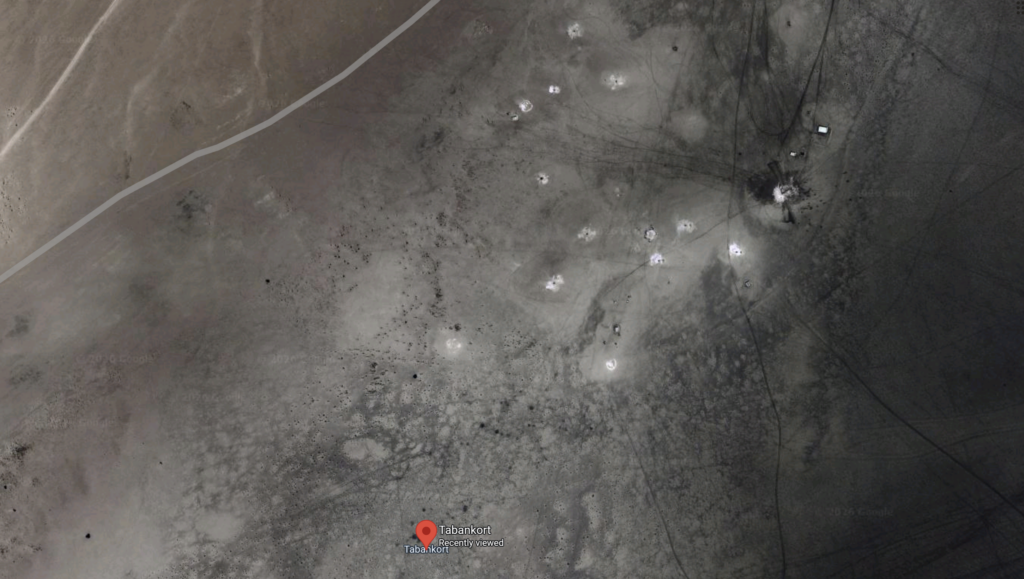
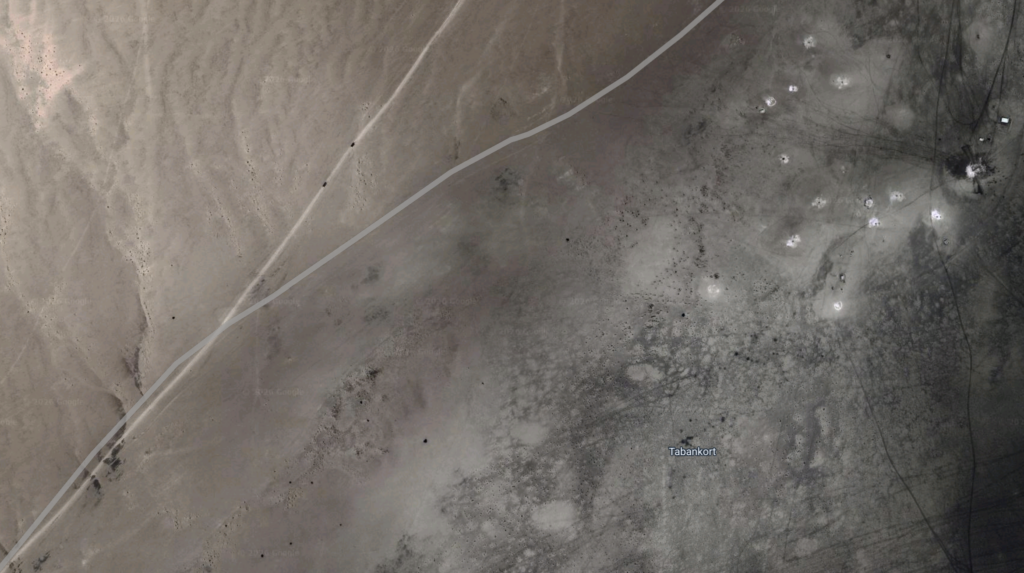
4 July seizure, 10 July recapture, 18 July ambush The Anefis–Gao axis. Anefis was seized by FLA and JNIM on 4 July 2026, retaken by FAMa on 10 July, and the convoy departing it was ambushed near Tabankort on 18 July. This is an Approximation of the region of the ambush and execution site not an exact geolocation.
the operation
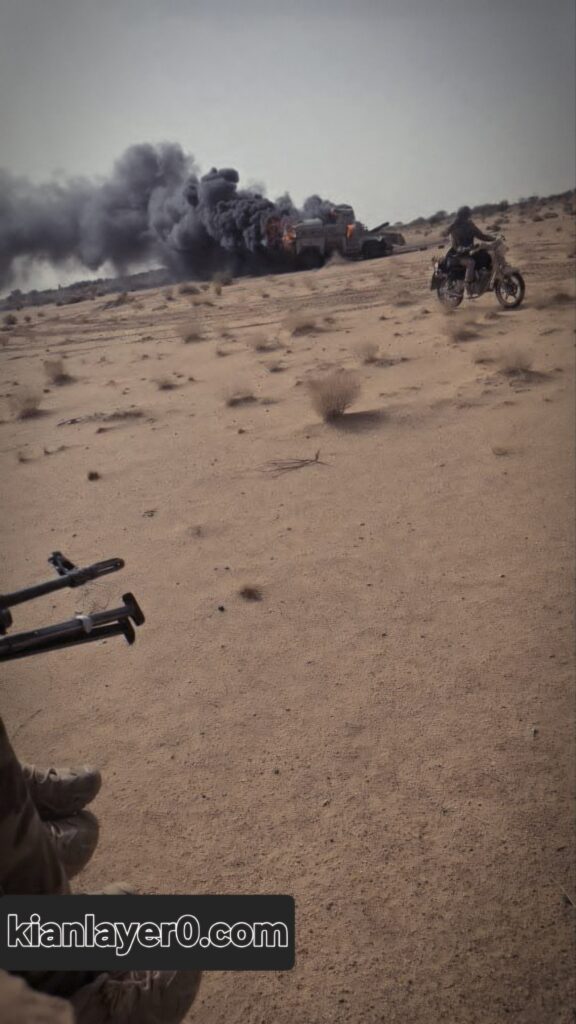
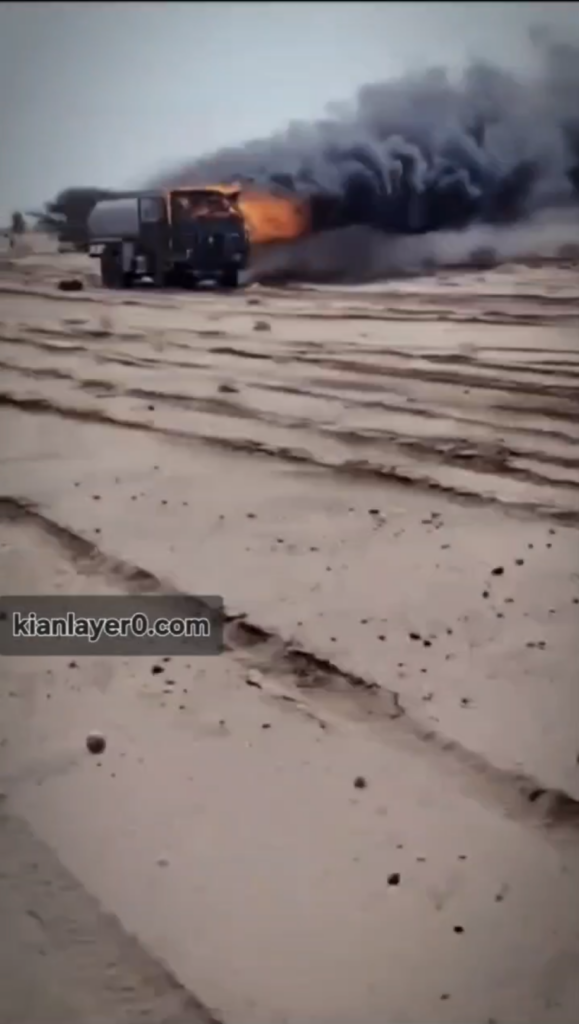
The attack itself is documented from its first moment. Photographs 1 and 2 in this release show an improvised explosive device and a destroyed vehicle: the ambush was IED-initiated, then pressed with direct fire along the column. Videos from the attacking force show technicals moving on the axis and the convoy’s vehicles including the fuel tankers halted, seized or burning.
This much was combat. In a non-international armed conflict, soldiers and their logistics are lawful military objectives, and an ambush on a military convoy, however destructive, is not a war crime. That precision is stated here deliberately, because everything that follows depends on the line it draws. The violations documented in this article begin at the moment resistance ended and in this incident that moment is unusually well defined, because the perpetrators filmed it themselves.
the record, and how to read it
Every video and photograph in this archive’s holding on Tabankort is published in this article, numbered as held: Videos 0 through 28, Photographs 1 through 17, with the perpetrator-released material preserved unedited in the evidentiary archive and presented here in the site’s standard edited form. Three grades of language are used throughout, as in every case file on this site. Confirmed means visible in the footage or established by independent corroboration. Assessed means inferred from the pattern of the evidence, stated as inference. Claimed means asserted by a party and not independently verified. The reconstruction below is built almost entirely from the first category. Where it relies on the second, it says so. Two clips sit across phase boundaries and are listed in both phases they document: Video 16 carries transit-killing and survey material, and Video 23 carries survey and burial material. The phase ranges below therefore overlap at those two numbers by design, not by error.
reconstruction — a timeline from the perpetrators’ own cameras
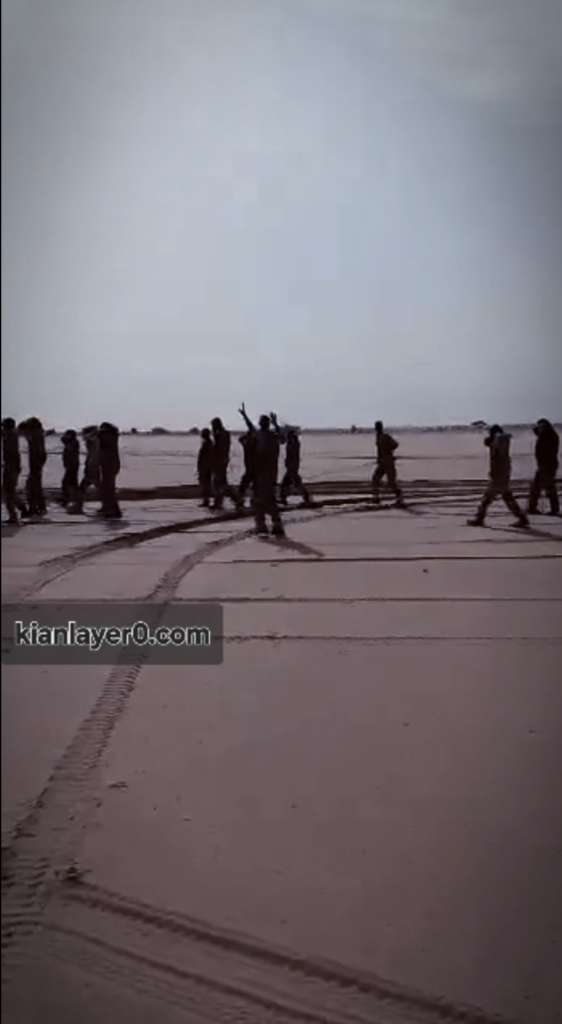
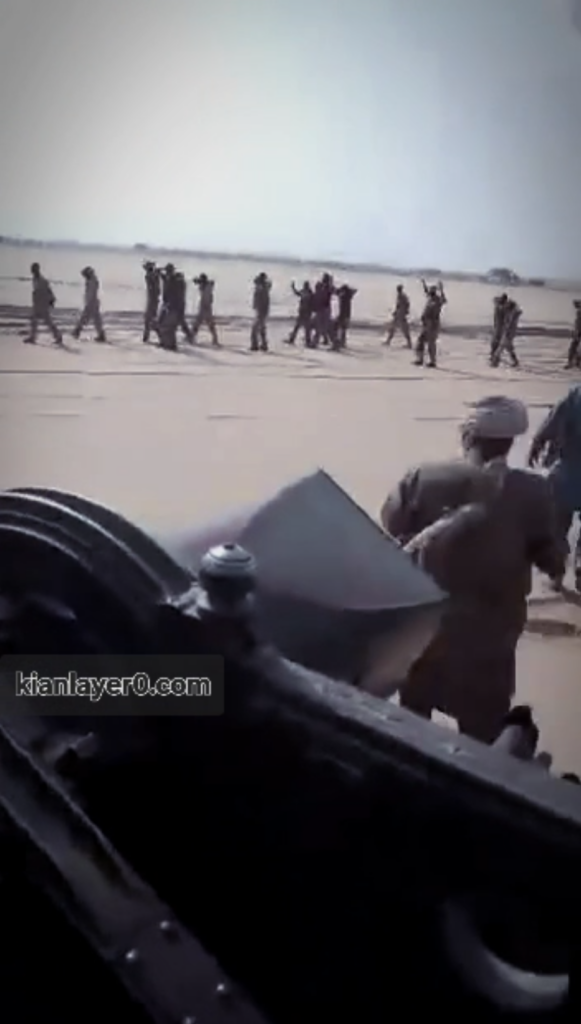
Phase one, surrender and capture. Videos 0 through 6 (2) document the immediate aftermath of the ambush: Malian soldiers surrendering in numbers. Columns of men walk under guard with their hands raised or clasped behind their heads disarmed, compliant, offering no resistance filmed from the attackers’ vehicles and gun positions as they pass. In single frames, more than a dozen prisoners are visible at once; across the phase-one videos the columns repeat from multiple camera positions. This is the material the wires described within a day: AP reported footage of soldiers lined up in surrender, surrounded by fighters and captured Malian military vehicles. Confirmed, on the perpetrators’ own film and in contemporaneous independent reporting.
Videos 0–6(2) — FAMa soldiers surrendering and marched under guard following the ambush; captured convoy vehicles visible. Islamic Nasheed music edited out where applicable.
Phase two, transport into the desert. The prisoners are loaded and driven away from the road some on the convoy’s own captured trucks, others distributed across the attackers’ smaller vehicles. The transport legs are filmed in both directions, and the return legs are their own evidence: large trucks filmed driving toward the execution area loaded, and filmed coming back empty. Video 2 and Video 5 hold both halves of that movement. Men filmed alive, in custody, driven out; vehicles filmed returning without them. Confirmed as movement on the footage; the sequencing of individual vehicles is assessed from vehicle matching across clips.
Transport and return Videos 2 and 5 — prisoners transported into open desert on captured FAMa trucks and escort vehicles; the same trucks filmed returning empty. Islamic Nasheed music edited out where applicable.
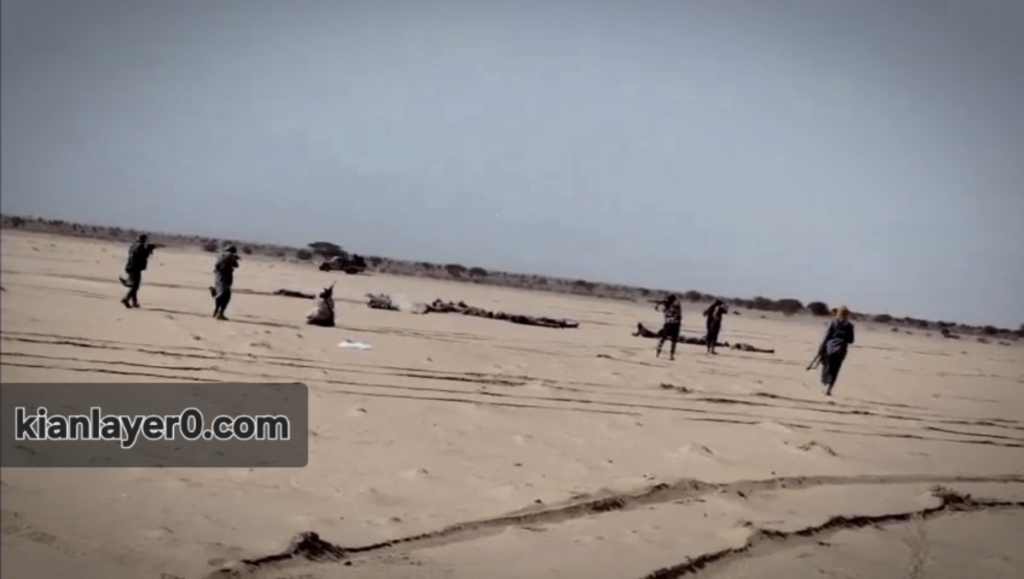
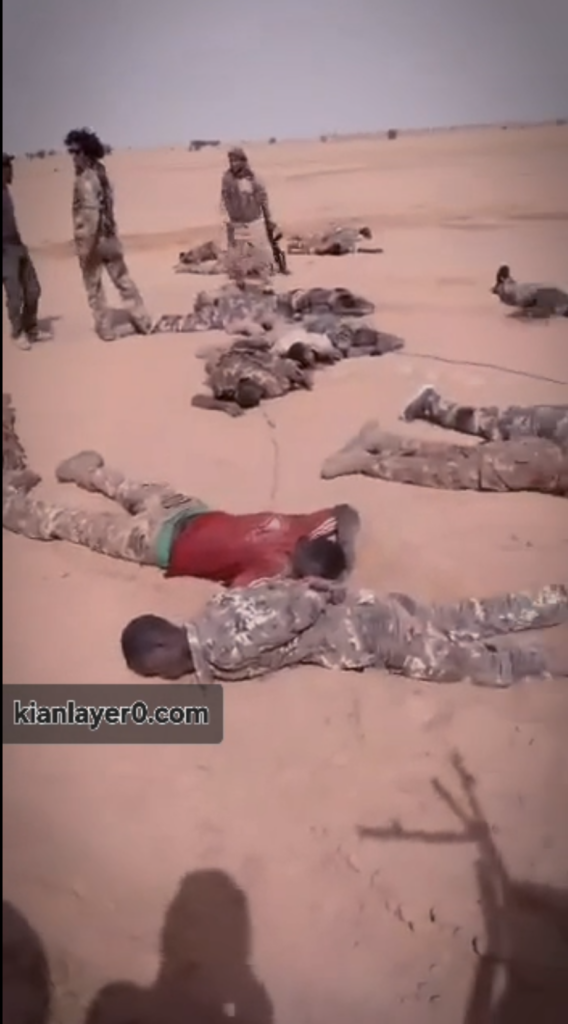
Phase three, the primary killing site. Video 7, held in this archive in multiple versions and published here in full, documents the main execution. At least 20 prisoners, bound are shot with Kalashnikov-pattern rifles by a line of fighters at close range. The men are on the ground. They are tied. None is armed; none resists; several are shot where they lie after the first volleys. The count approximately 20 at this site alone is a footage-derived minimum from this archive’s frame-by-frame review. The status of the victims is not inferred from circumstance: the same cameras that filmed the killing filmed the surrender and the binding that preceded it. Confirmed.
Video 7 (full) and 9 (2) full video with follow up footage from the camera man — the execution of approximately 20 bound FAMa prisoners at the primary killing site. Published in full for evidentiary completeness. Islamic Nasheed music edited out where applicable.
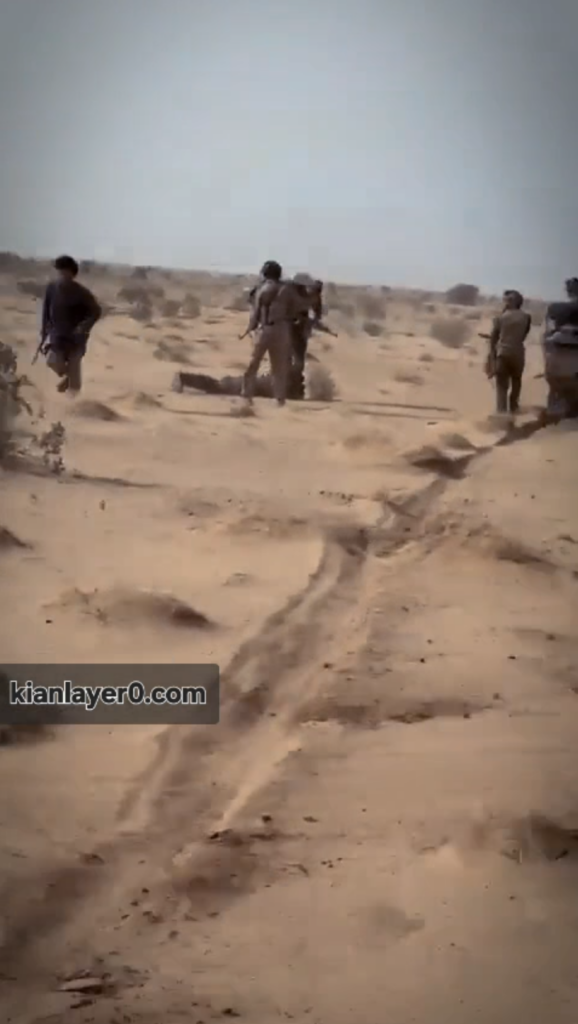
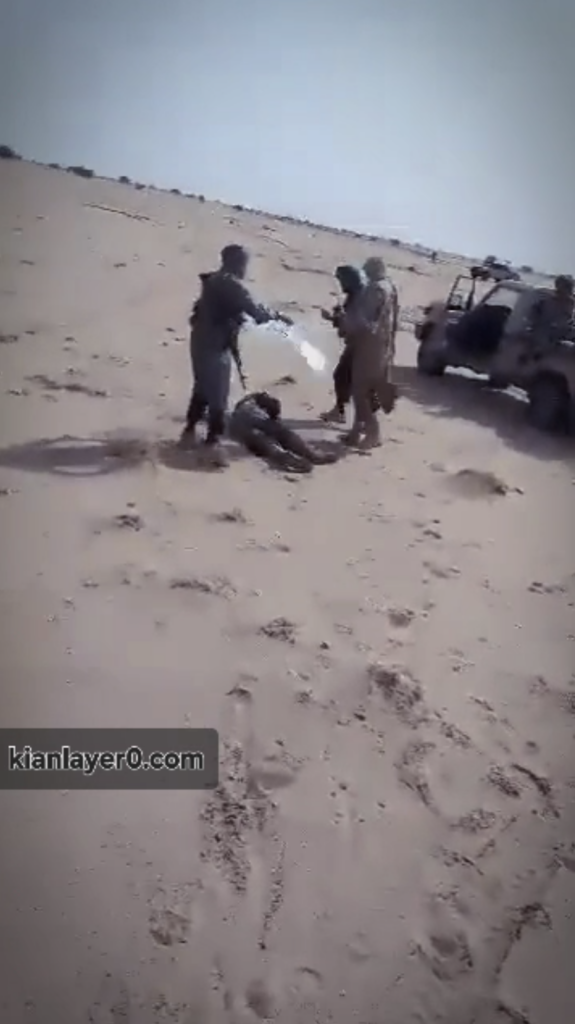
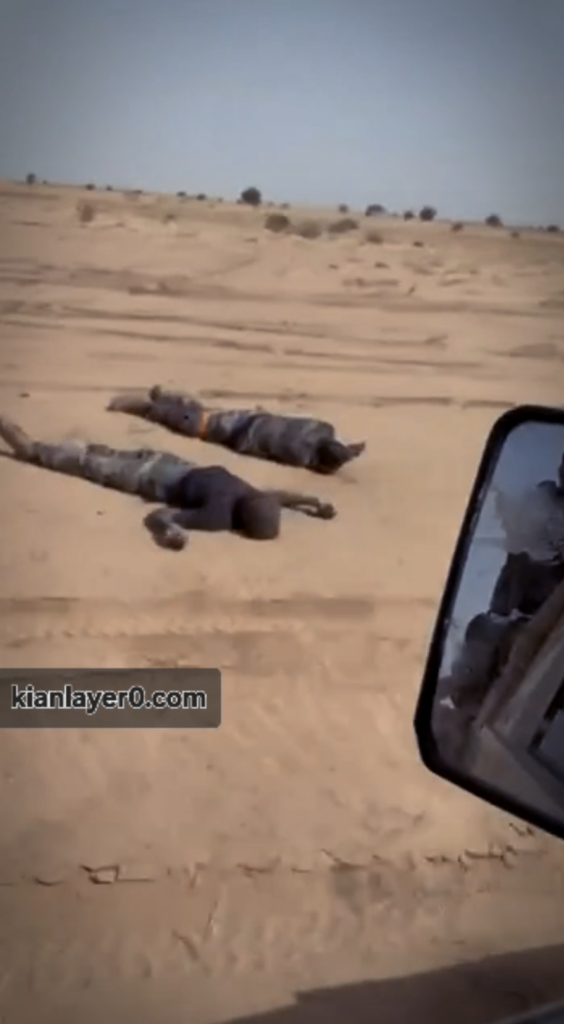
Phase four, the killings in transit. Videos 8 through 16 document executions at multiple points along the approach route, separate from the primary site. A vehicle stops while a prisoner is taken out and shot. A prisoner is beaten and restrained before being killed. Two more prisoners are killed in a sequence in which a fighter carries a white standard bearing the shahada, placing JNIM-aligned elements at that killing. Further killings follow in the Video 10 and Video 15 series. The result, documented in phase five, is not one killing ground but a string of them: clusters of executed men at intervals along the route.
What explains the clusters is graded here as assessment, not record. The pattern on the footage is consistent with the following mechanism: the main body of prisoners was moved on the large trucks and executed at the primary site; prisoners following in smaller vehicles saw or learned of the killings ahead; those prisoners were taken out and shot where their vehicles stood; and the remaining escorts killed their prisoners before arrival rather than deliver witnesses a sequence that implies coordination across the column as it moved. That mechanism is offered as the assessment that best fits the spatial evidence. What does not depend on it is confirmed: men filmed alive in custody on these vehicles, on this route, and the same route marked afterwards by cluster after cluster of the executed. The mechanism is assessed. The killings are filmed.
Videos 8–16 — executions of individual and small groups of prisoners at multiple points along the route; a prisoner beaten and restrained before being shot. Islamic Nasheed music edited out where applicable.
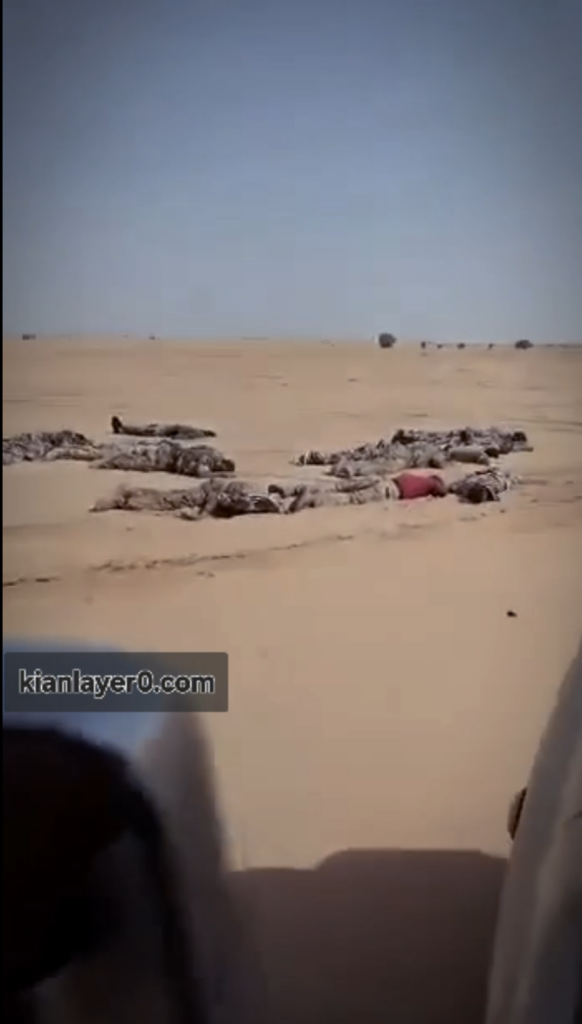
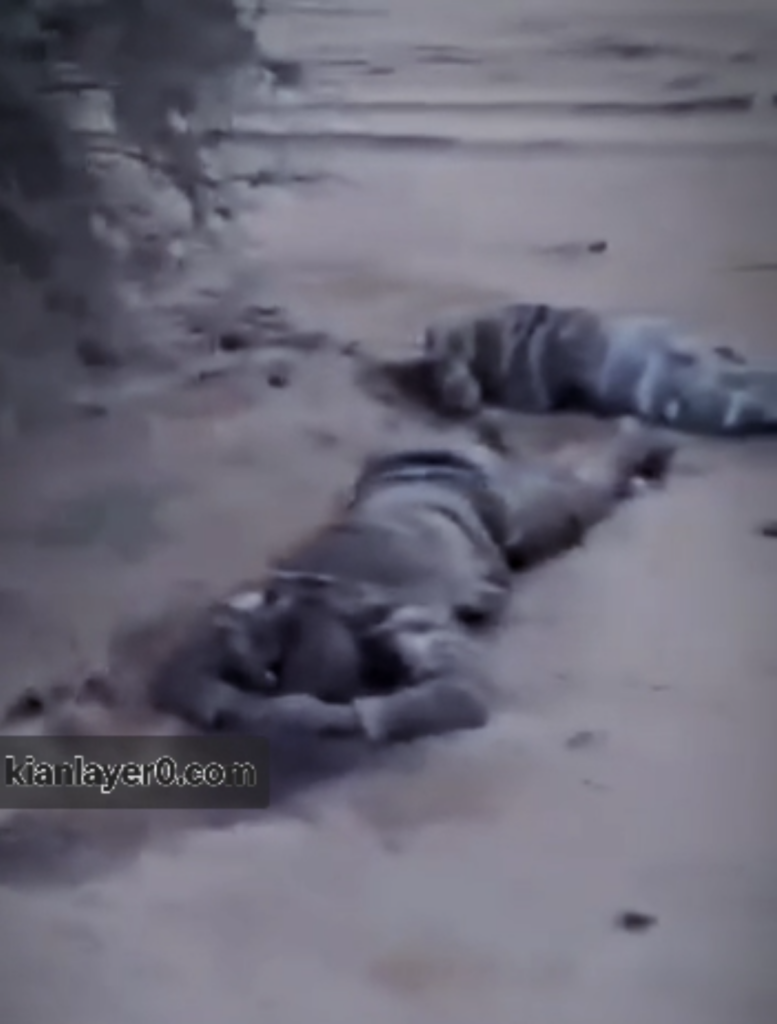
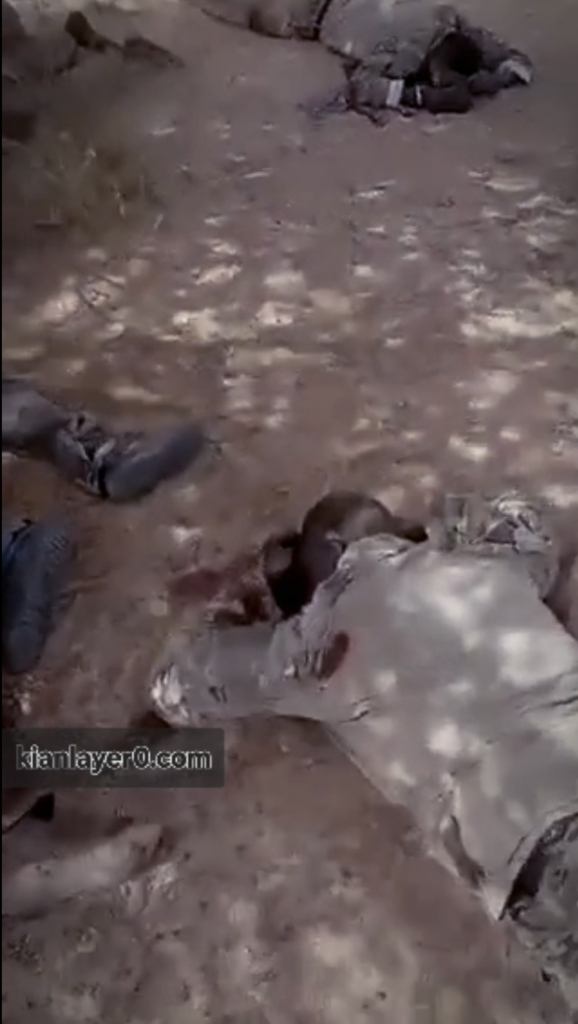
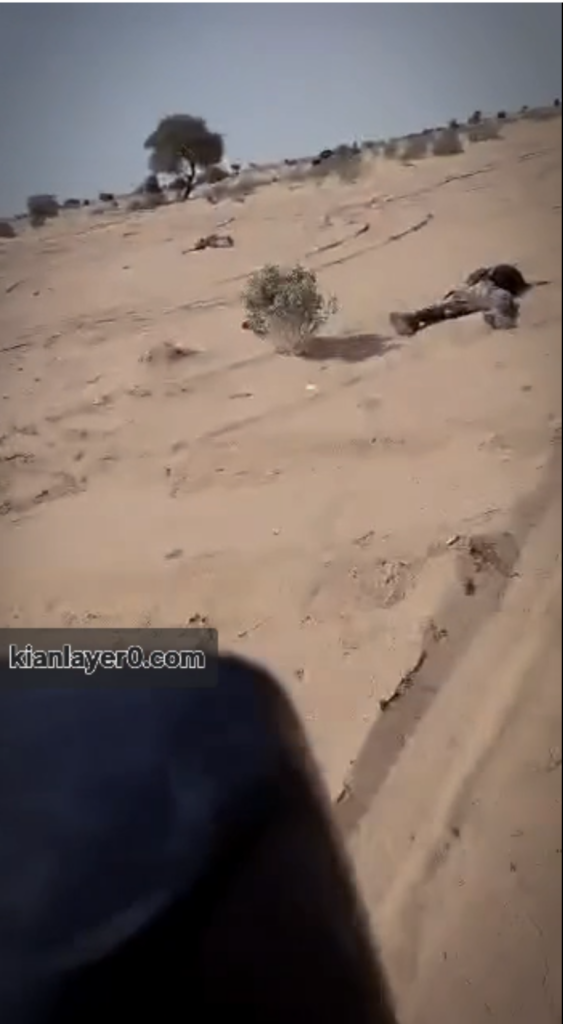
Phase five, the survey. Videos 17 through 22 are the perpetrators’ own confirmation pass: vehicles driving slowly past the clusters of the dead, filming group after group of executed soldiers lying where they were shot, at length and deliberately. Photographs 3 through 16 in this release are stills of the same body-cluster sites. This material serves the perpetrators as proof of the kill. It serves this documentation as the body-count floor and the geography of the crime scenes. Confirmed.
Videos 17–22 — the perpetrators film the clusters of the dead along the route. Islamic Nasheed music edited out where applicable.
Photographs 3–16: the body-cluster sites. Photograph 17: this archive’s deduplication tally worksheet, published as part of the evidentiary method.
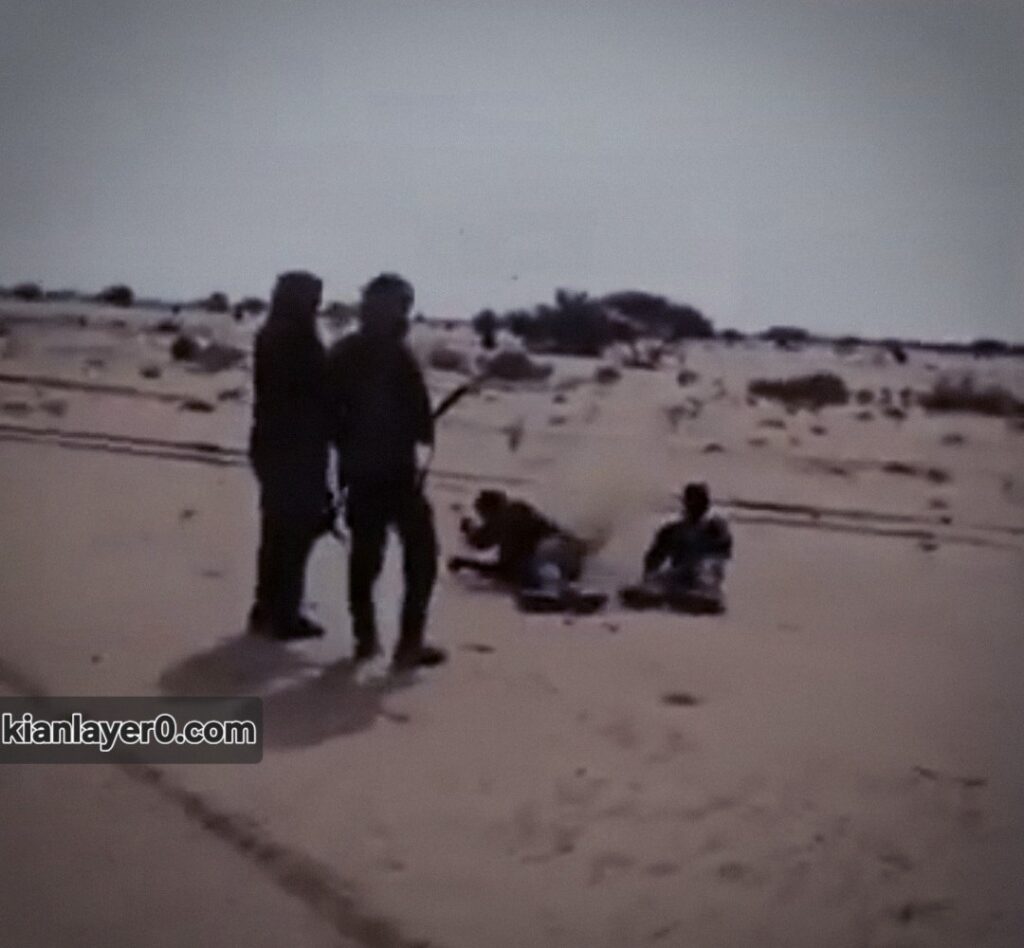
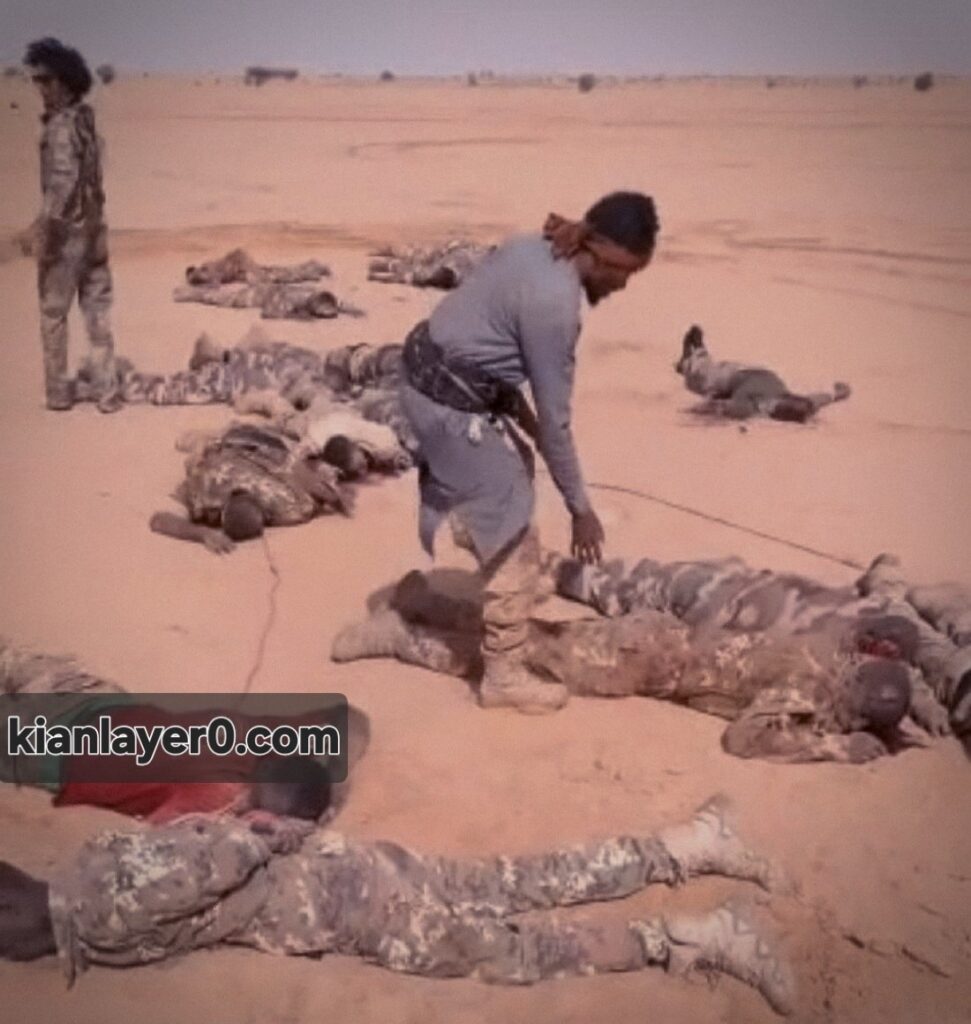
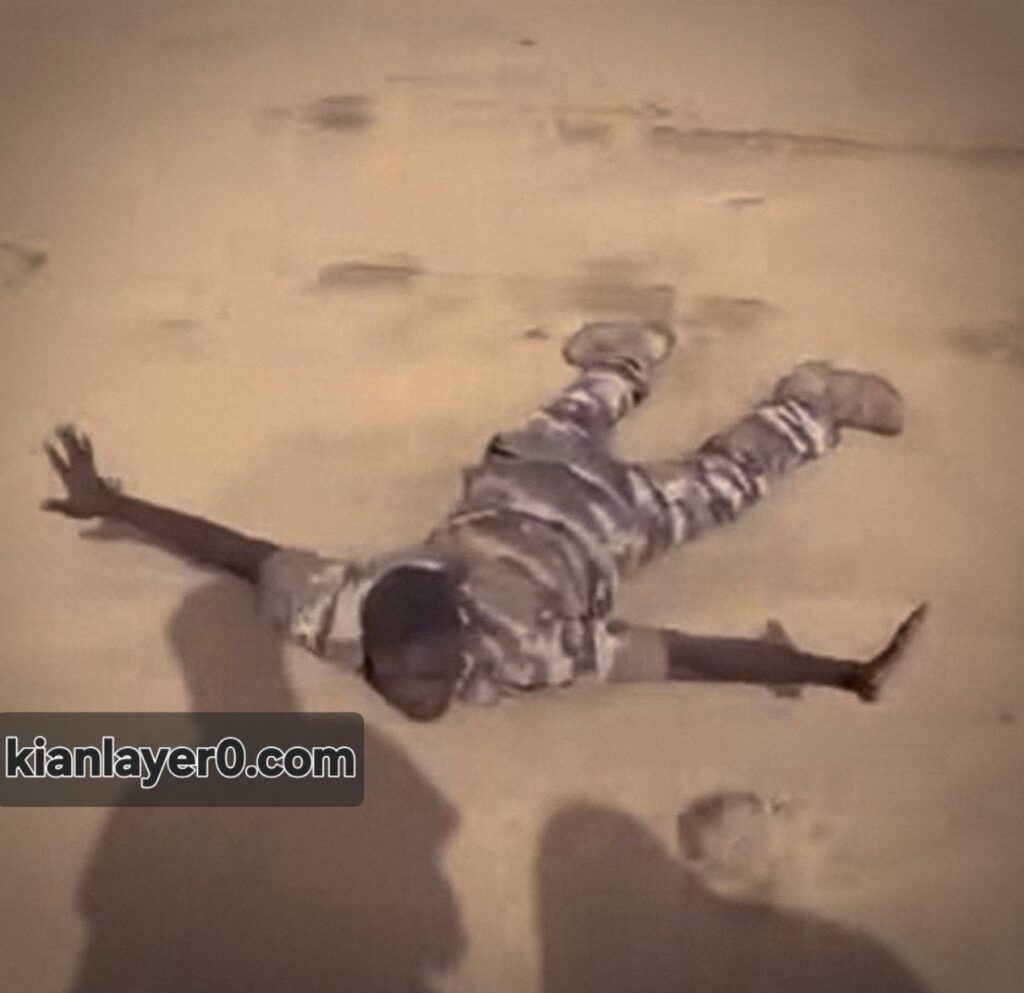
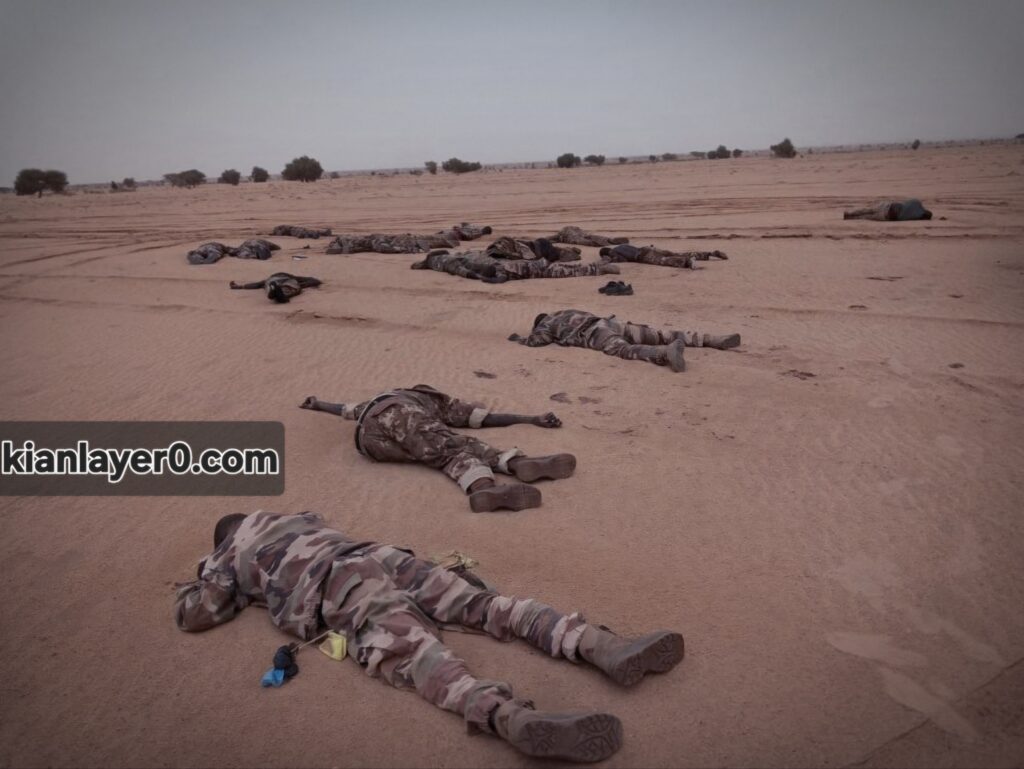
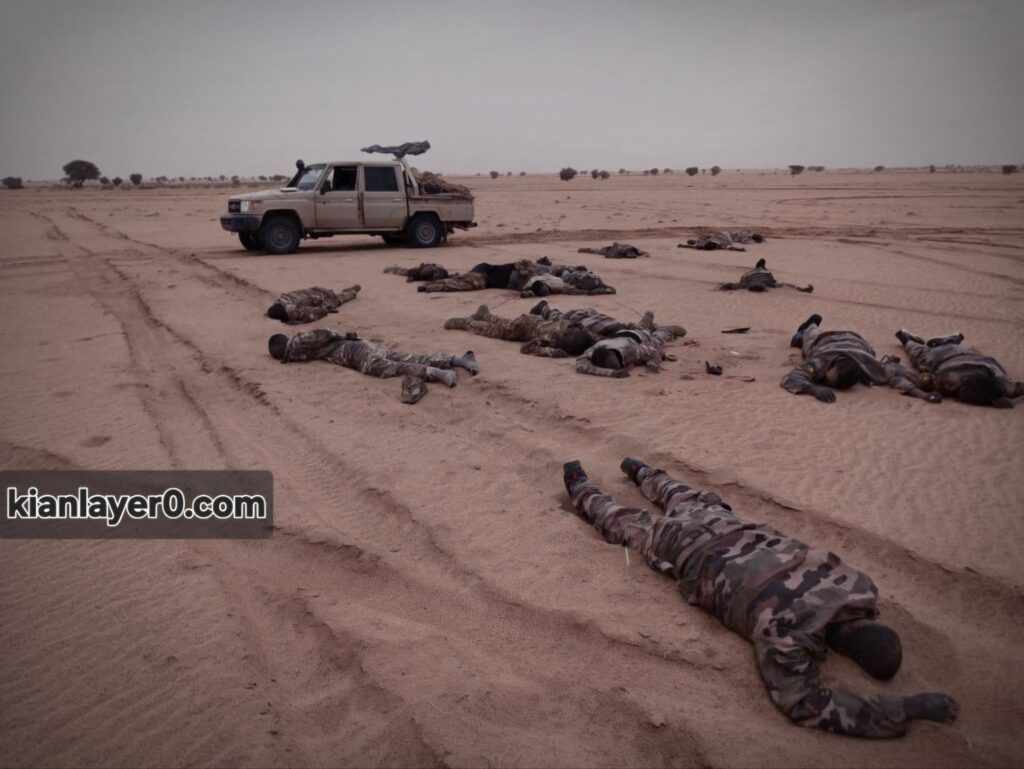
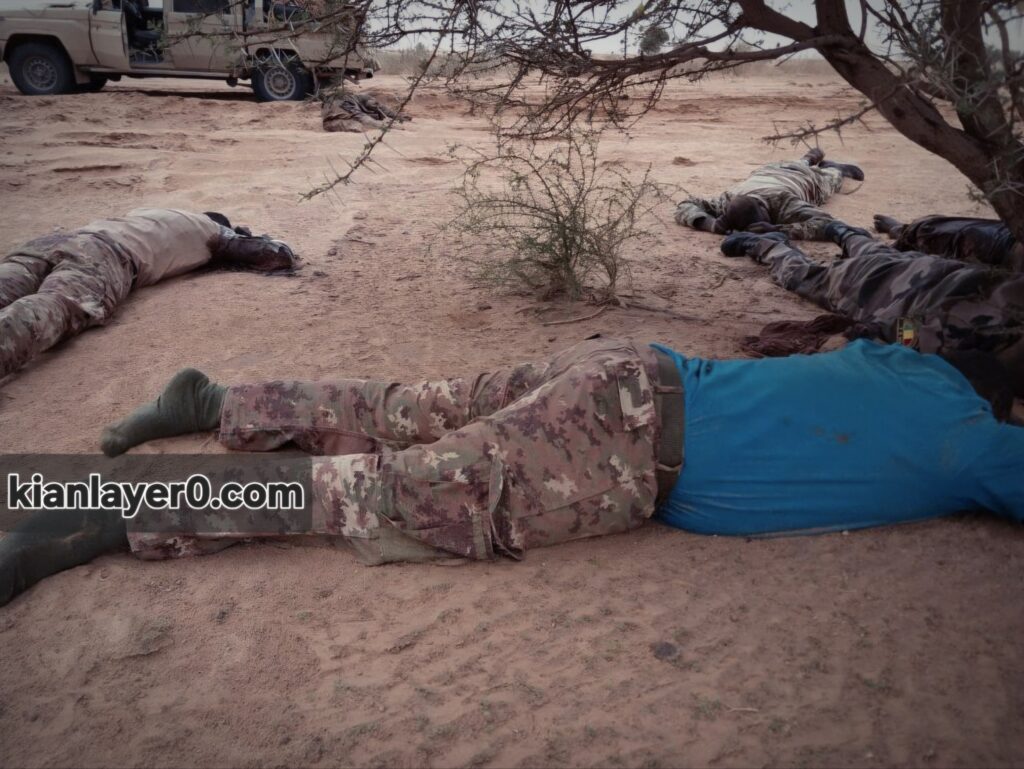
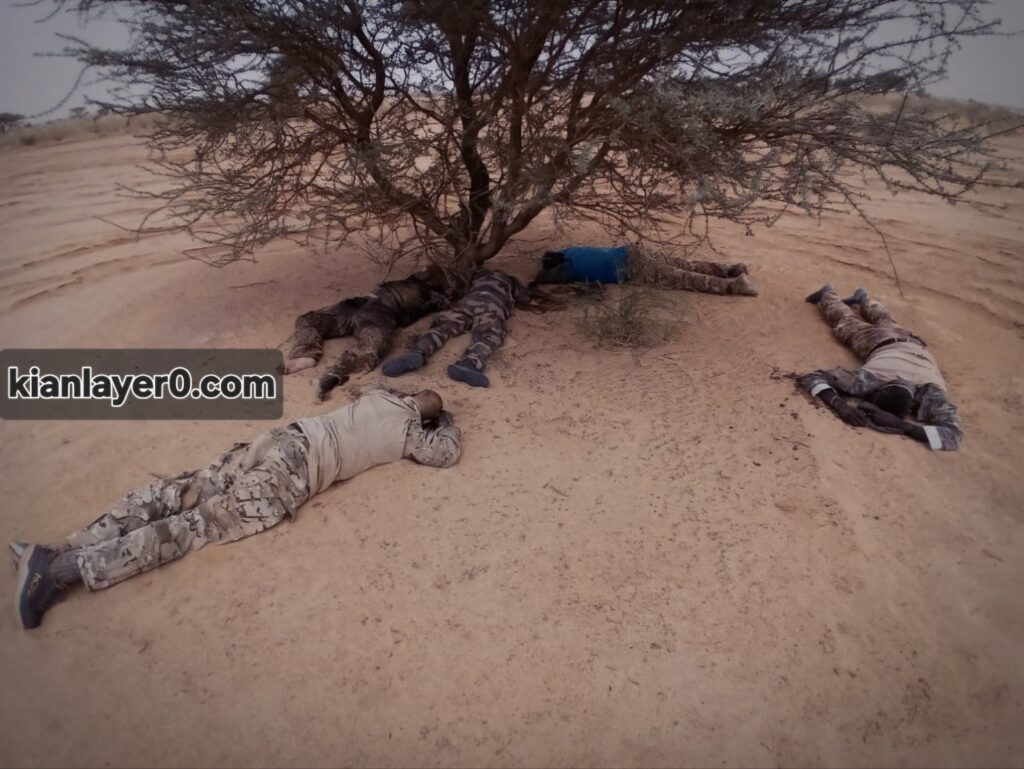
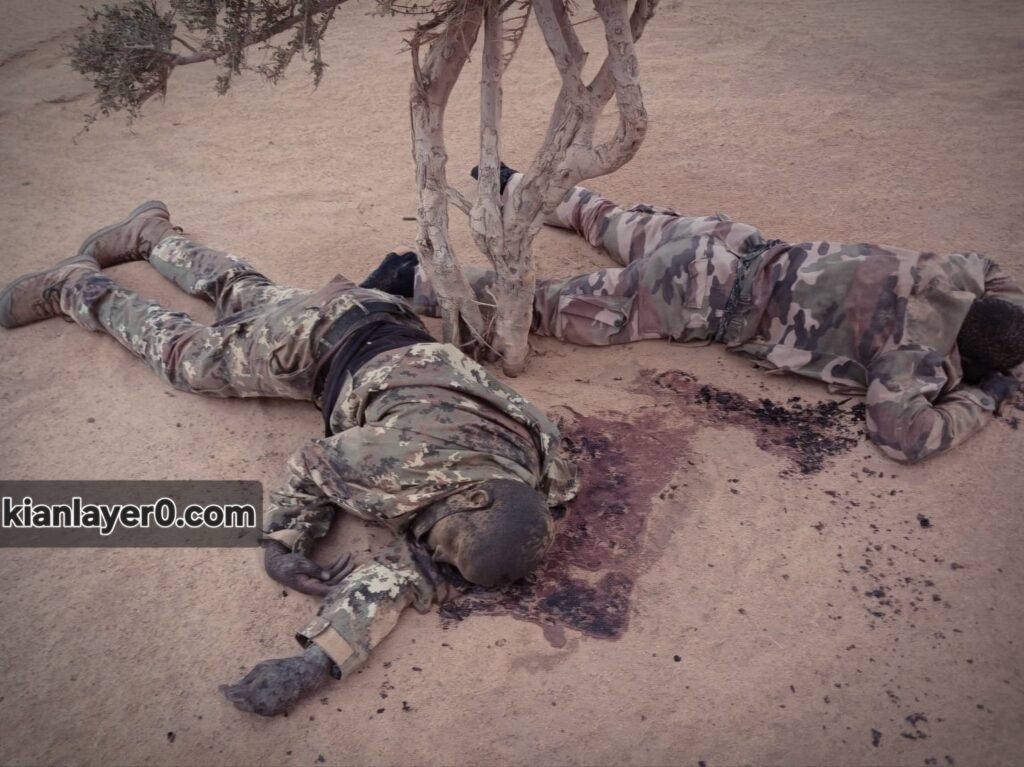
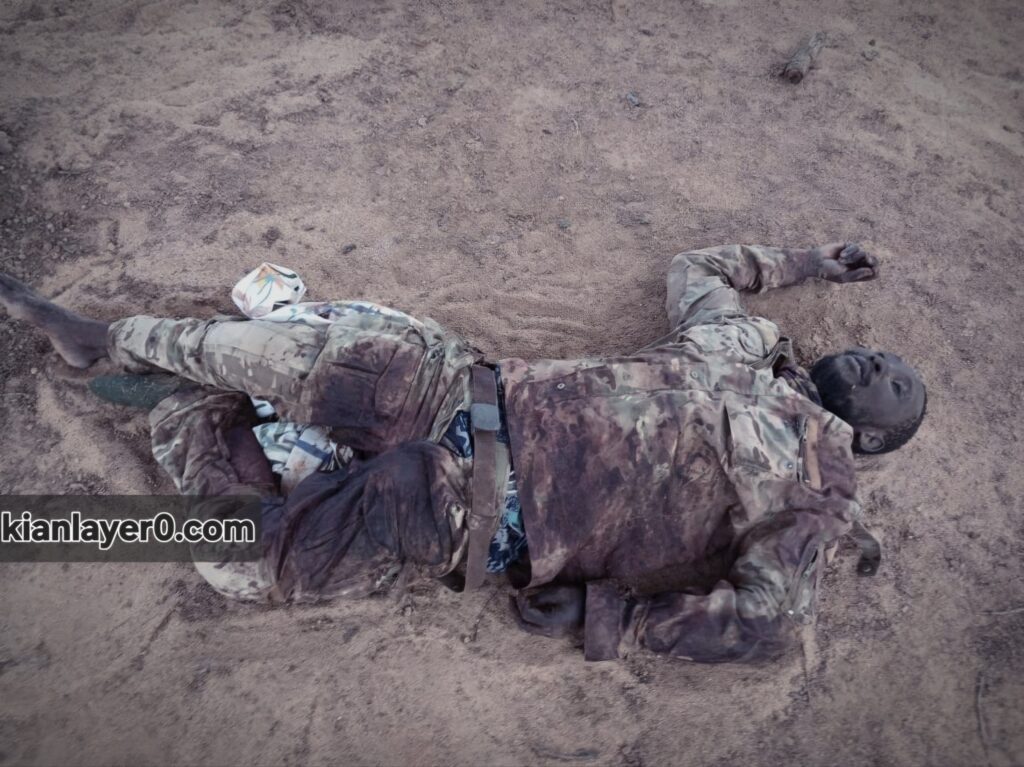
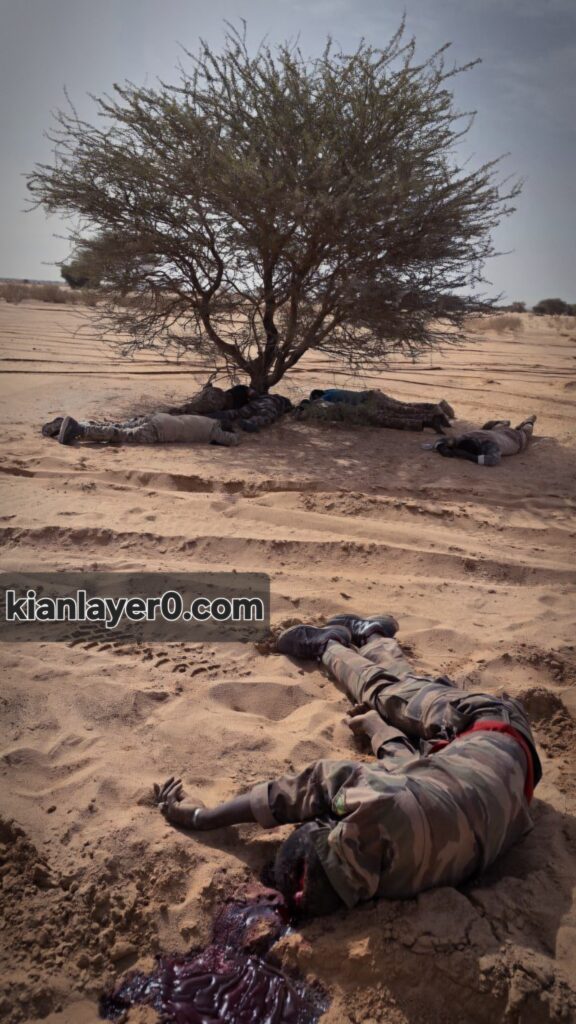
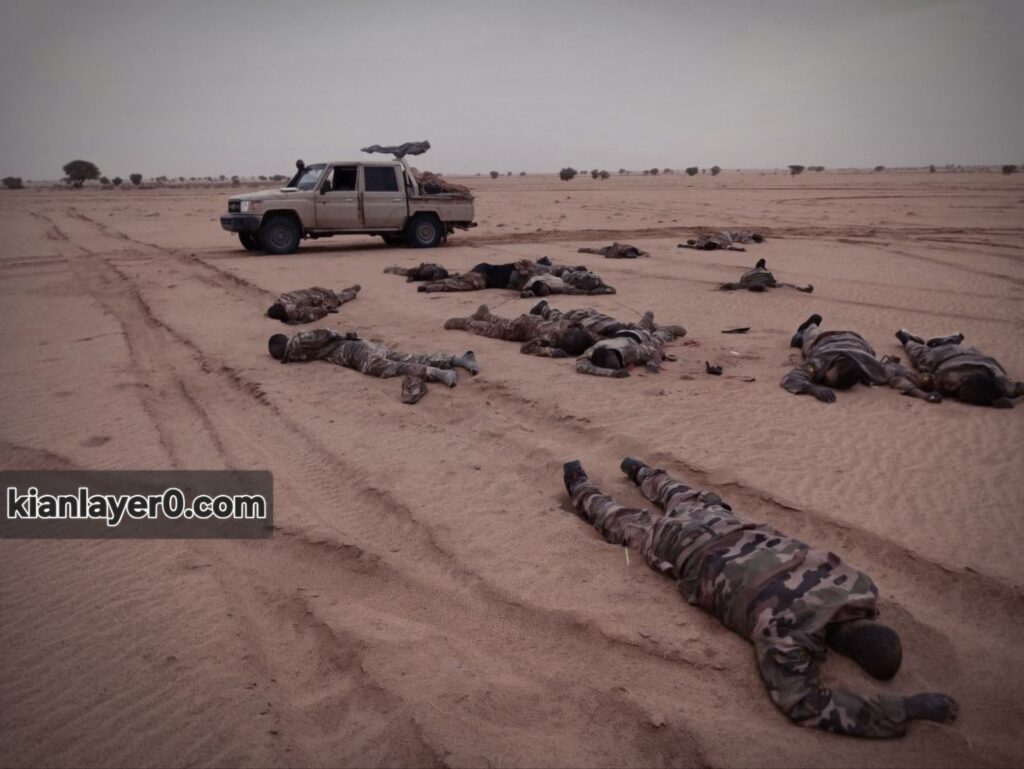
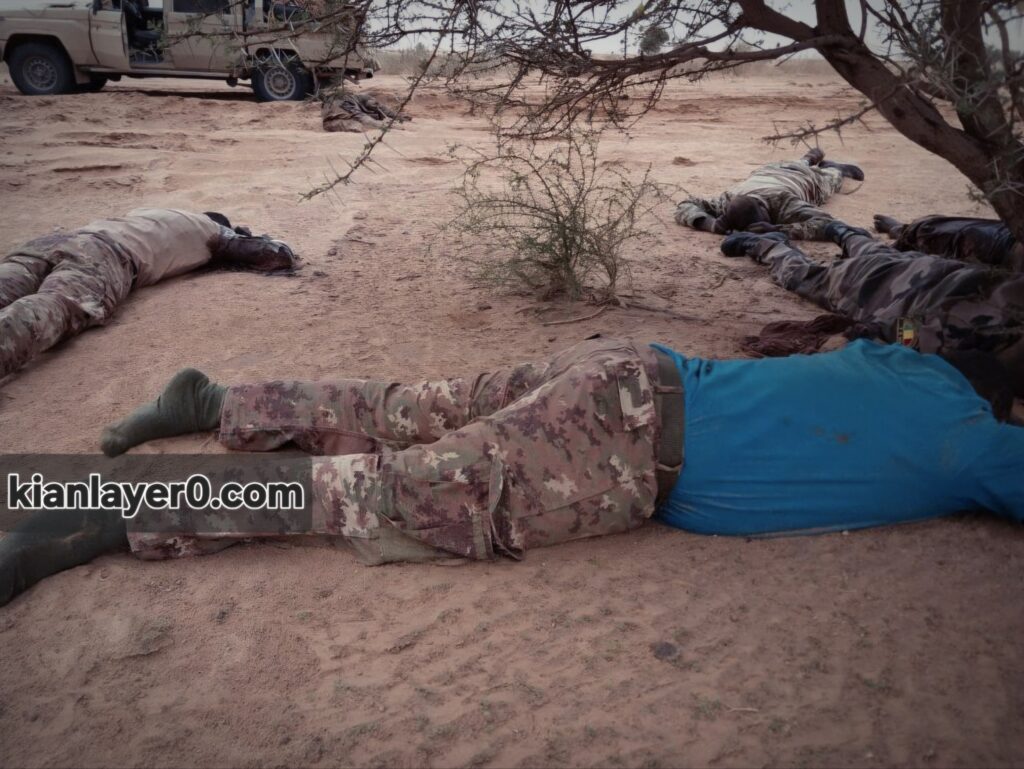
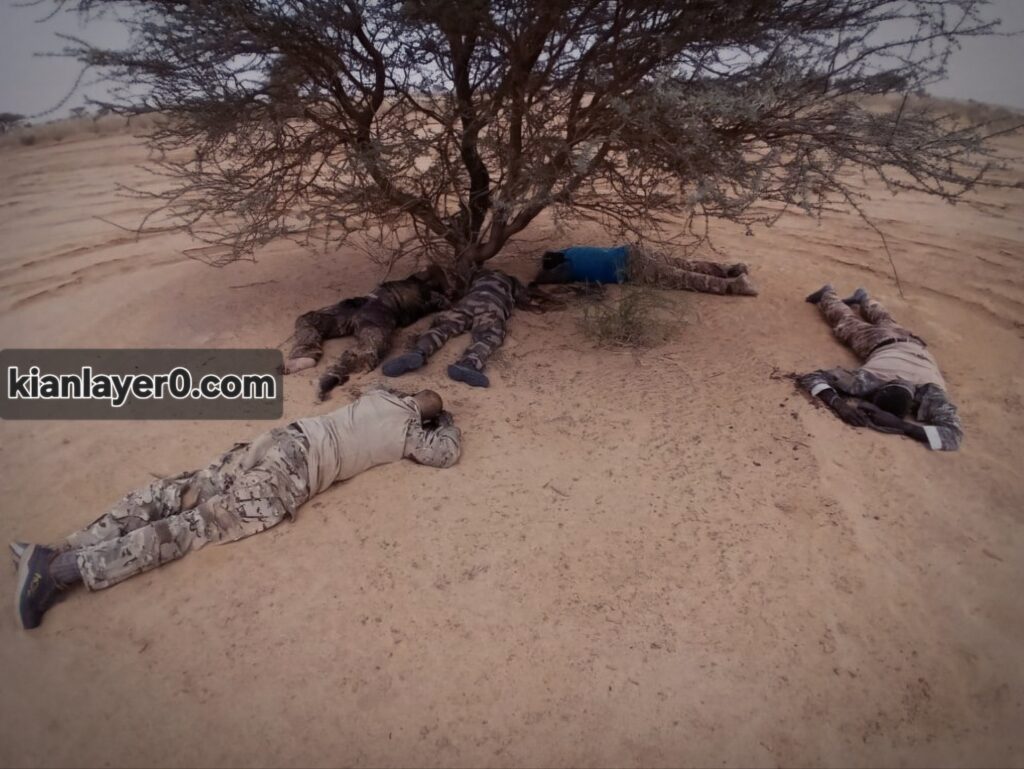
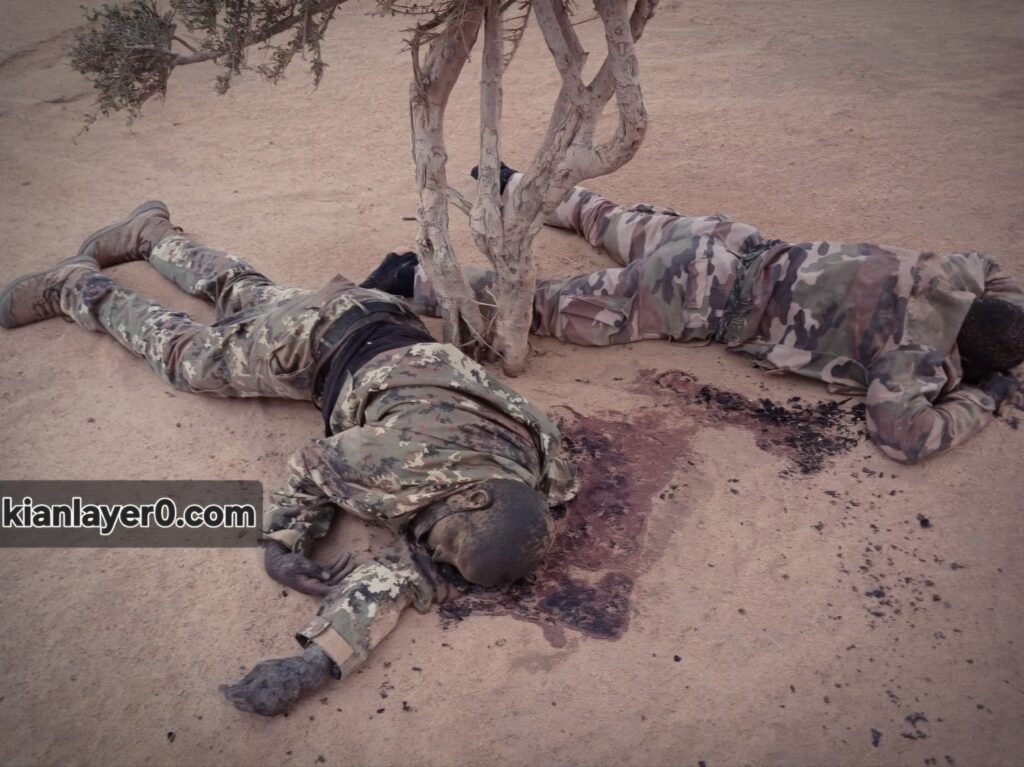
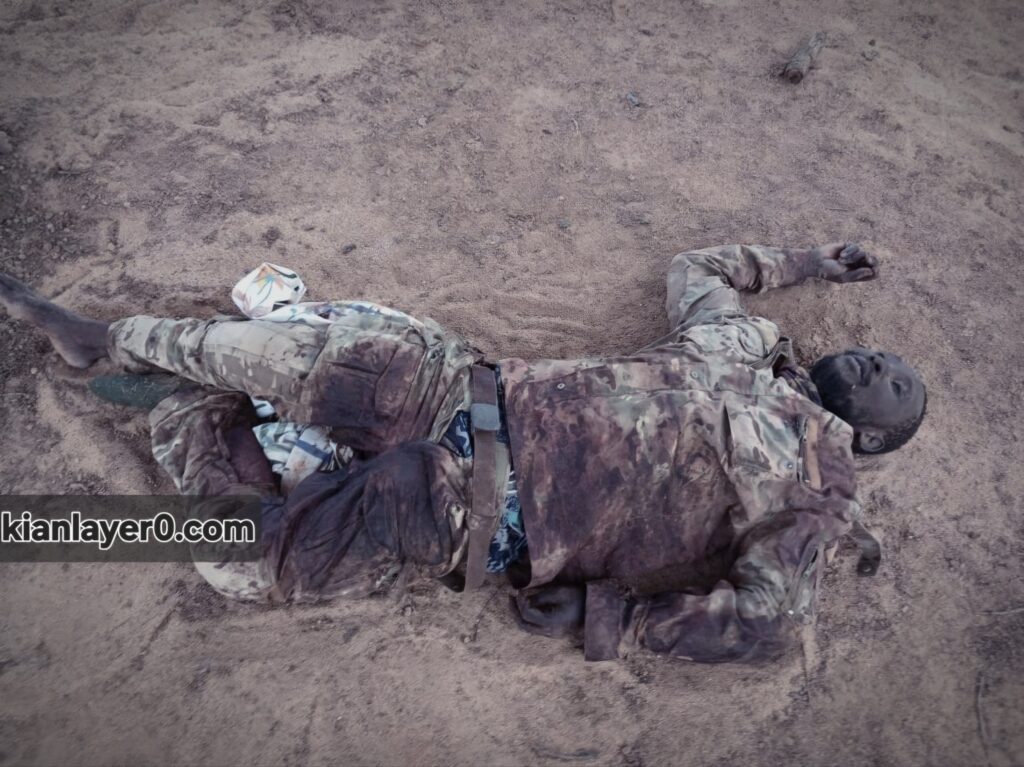
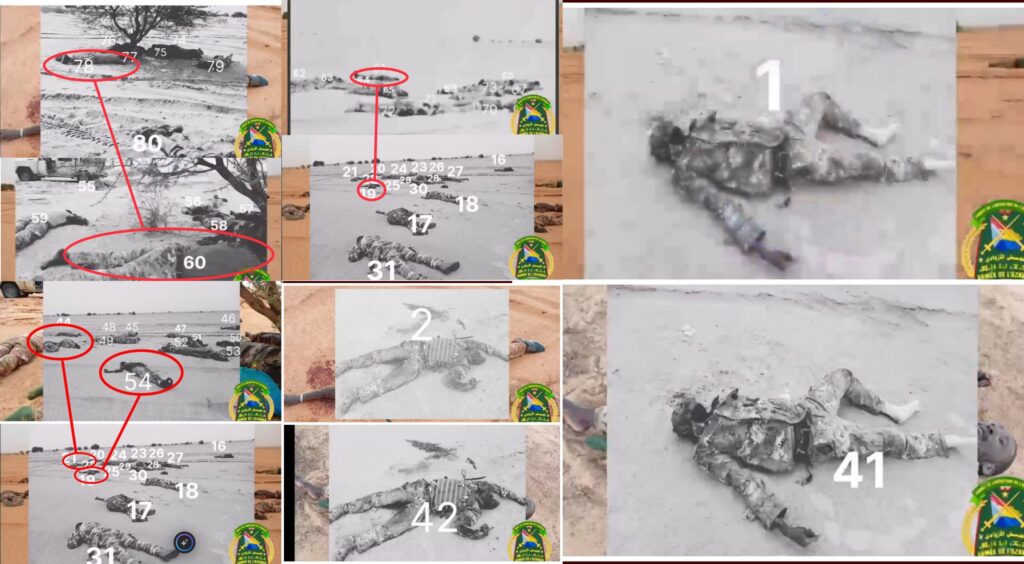
Phase six, abandonment, and a late burial. The dead were not buried by the men who killed them. They were left in the open desert, filmed repeatedly by the vehicles of the force that executed them, and abandoned. Days later, footage circulated of burials at the site, Videos 23 and 24, carried by channels whose captioning attributes the work to units of the armed forces of Azawad, at a locality given as Tabrichat. Wire reporting placed the ambush near Tabankort; both reference points sit on the Anefis–Gao axis, and the precise siting of the execution areas against each is under geolocation. The attribution of the burial is claimed. What the burial footage confirms is not in the caption: that the bodies lay unburied where they fell until after the footage of their killing had circulated worldwide, and that the forces which claimed this operation retained access to and control of the ground on which its victims lay. The legal weight of both facts is set out below.
Videos 23–24 — burial of the abandoned dead, days after the massacre, attributed in the source captioning to units of the armed forces of Azawad.
Phase seven, the families. Videos 25 through 28 are addressed in their own section, because they belong to a different category of evidence, and to a different register.
casualties, claimed vs documented
The confirmed floor: at least 20 bound prisoners executed at the primary site, counted frame by frame from Video 7, plus the separate cluster killings documented across phases four and five at multiple distinct locations. The deduplicated minimum across all footage and photographs counted per clip and reconciled by clothing, position, wounds and terrain, with the tally sheet preserved as part of the evidentiary record stands at is in preparation. The tally worksheet is published here as Photograph 17 as part of the evidentiary method, and the deduplicated figure will be added to this section as a dated update. The worksheet is published as Photograph 17. The United Nations Human Rights Office characterised the toll as dozens of surrendering soldiers reported tortured and killed. A source close to the FLA told Reuters that more than 50 pro-government fighters had been killed, and the FLA’s own statement claimed dozens captured and many killed; the Malian army has published no casualty figure for the ambush. Both figures are claimed and are recorded here as such. Neither displaces the footage-derived floor above, which is a minimum and not an estimate. And one category must be stated on its own: prisoners filmed alive in the custody of these groups who do not appear among the documented dead were last seen alive in the hands of JNIM and the FLA. Responsibility for their treatment and their fate has rested with those organisations from the moment of capture, and it does not lapse.
the legal threshold, what is and is not the crime
Precision matters here, as it did at Baidoa. The ambush was combat. The crimes begin where the perpetrators’ own cameras show resistance ending at the raised hands, the marched columns, the binding. From that moment, every man in the record was a person hors de combat by detention, and everything done to him is measured against the law of captivity, not the law of battle. The footage documents at least three distinct classes of chargeable conduct: the execution of individual and small groups of bound prisoners in transit, each a separately chargeable incident with its own victims and in most cases its own identifiable shooters; the organised mass execution of at least 20 bound prisoners at the primary site; and the beating of restrained men awaiting execution. A fourth violation, the treatment of the dead is set out separately below.
applicable law
The law binding this conflict is thicker than it was at Baidoa, and the court that enforces it is already seized of this situation. Mali has been party to the four Geneva Conventions since 1965 and, unlike Somalia, ratified Additional Protocol II in 1989. The treaty law governing this conflict is therefore Common Article 3 together with AP II, which binds every party state and organised armed group alike where the conflict meets its threshold; JNIM’s sustained territorial control and organised command satisfy it. AP II Article 4 prohibits, at any time and in any place whatsoever, violence to the life of persons who have ceased to take part in hostilities, whether or not their liberty has been restricted murder first among the enumerated acts together with cruel treatment, torture, and outrages upon personal dignity. Article 4(1) adds the prohibition this incident’s structure invokes: it is forbidden to order that there shall be no survivors. Customary international humanitarian law as catalogued by the ICRC states the same obligations persons hors de combat may not be attacked (Rule 47), must be treated humanely (Rule 87), may not be murdered (Rule 89), and adds the duties owed to the dead (Rules 113 and 115). The Rome Statute’s Article 8(2)(c) criminalises serious violations of Common Article 3 committed against persons taking no active part in hostilities, “including members of armed forces who have laid down their arms and those placed hors de combat by sickness, wounds, detention or any other cause.”
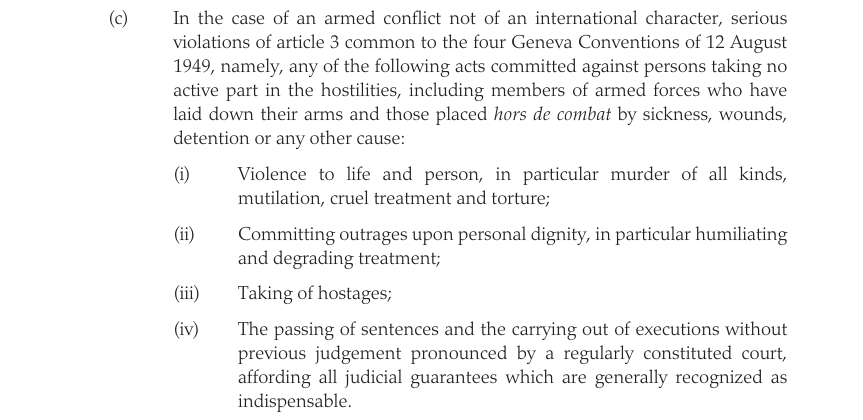
Detention is the operative word. At Baidoa the victims were hors de combat by wounds, and status had to be established from their condition. At Tabankort the perpetrators removed all interpretive distance themselves: they accepted surrenders, disarmed the prisoners, marched them, loaded them onto their own vehicles, and bound them. A bound prisoner is the paradigm case of a person hors de combat by detention. There is nowhere left to argue.
murder of persons hors de combat
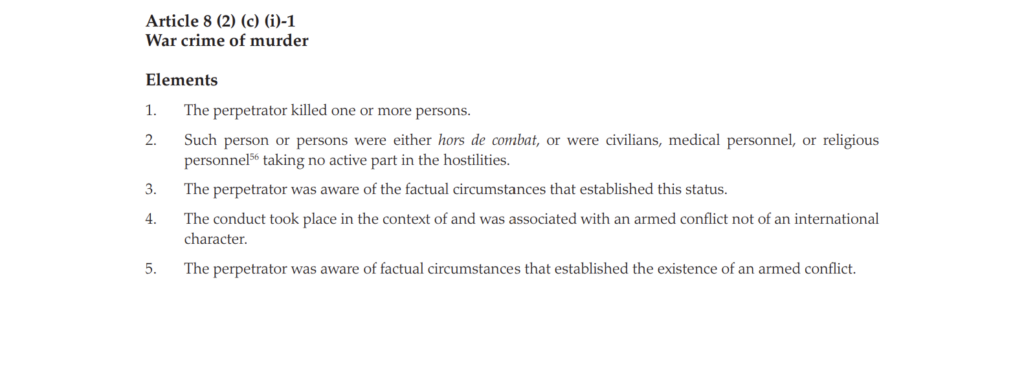
Murder of persons hors de combat, Article 8(2)(c)(i). The ICC’s Elements of Crimes sets out the offence in five elements: the perpetrator killed one or more persons; the victims were hors de combat or otherwise taking no active part in hostilities; the perpetrator was aware of the factual circumstances establishing that status; the conduct took place in the context of a non-international armed conflict; and the perpetrator was aware of the circumstances establishing that conflict. Every element is met on the face of this record, and met more completely than in any prior case file on this site. The victims’ status is established by the perpetrators’ own film of the surrender and the binding. Awareness of that status is not argued but recorded in the act of tying men before shooting them. The nexus is supplied by the ambush both organisations claimed in writing as their joint military operation the same day. And the description of the footage published by the UN Human Rights Office tracks the elements almost clause for clause: members of the two groups shooting soldiers who had already given themselves up, hands behind their heads. Each transit killing is independently chargeable under the same article. The primary-site execution of at least 20 bound men is chargeable as to every victim.
torture and cruel treatment
The killing was not the whole of it. The record shows a prisoner beaten and restrained before being shot, and the UN Human Rights Office spoke of reported torture as well as killing. The legal grading is stated precisely. The beating of a restrained captive awaiting execution constitutes cruel treatment under Article 8(2)(c)(i) and Common Article 3 on the face of the footage. Where the severity of suffering and its purpose, punishment, intimidation are established, the same conduct is chargeable as torture. And the structure of the massacre itself inflicted a further category of suffering that the law does not ignore: men held in vehicles on that route saw, or came to know, what was being done ahead of them before it was done to them. The filming and distribution of all of it as propaganda compounds the outrage upon personal dignity under Article 8(2)(c)(ii), as it did at Baidoa.
the dead, abandonment, and a late burial
The obligations of the law of armed conflict do not end at the moment of death. Under customary Rules 113 and 115, each party must take all possible measures to prevent the dead from being despoiled and must ensure that the dead are disposed of in a decent manner as far as circumstances permit; AP II Article 8 states the same duties in treaty form. The forces that executed these men did neither. They left the dead in the open desert, in the clusters where they were shot, and drove their cameras past them. The burial came days later after the footage had circulated worldwide and the United Nations had demanded an investigation performed, according to the captioning of the channels that released it, by units of the armed forces of Azawad. The attribution is theirs to make and is recorded here as claimed. What the burial footage establishes does not depend on the caption: the abandonment it ended, and the continued control of the ground by the forces that claimed the operation. A grave dug after the world has seen the footage does not bury the crime. It certifies the abandonment that preceded it.
the united nations, on the record
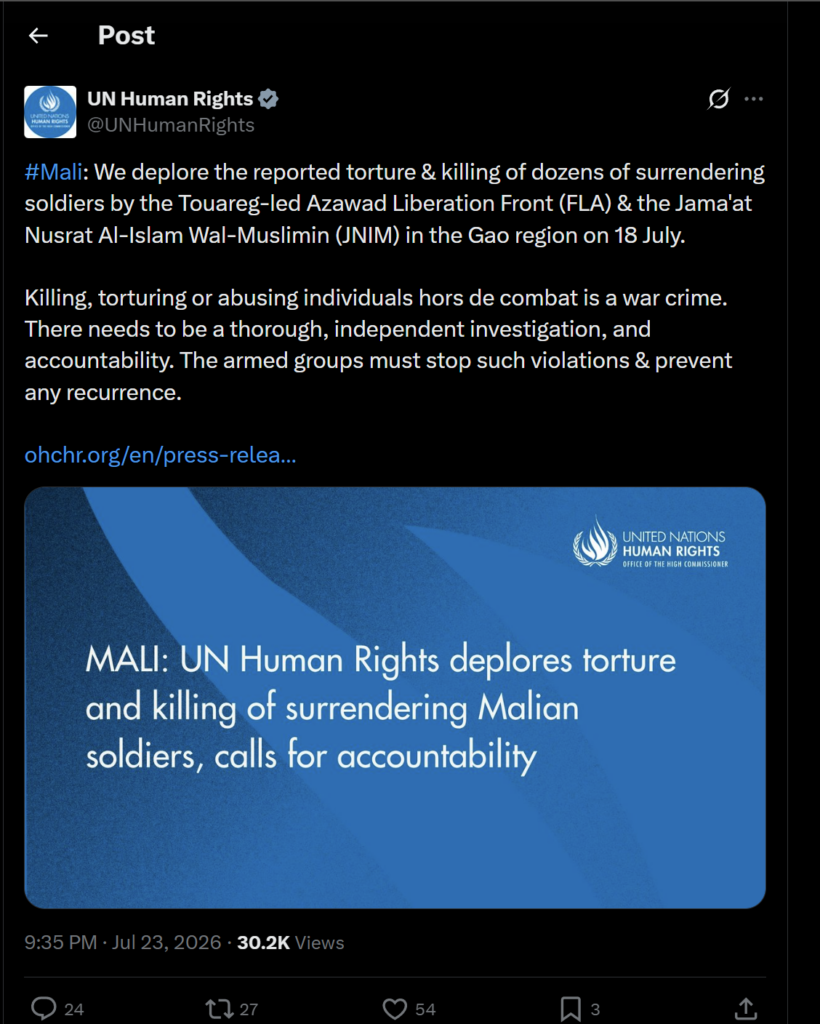
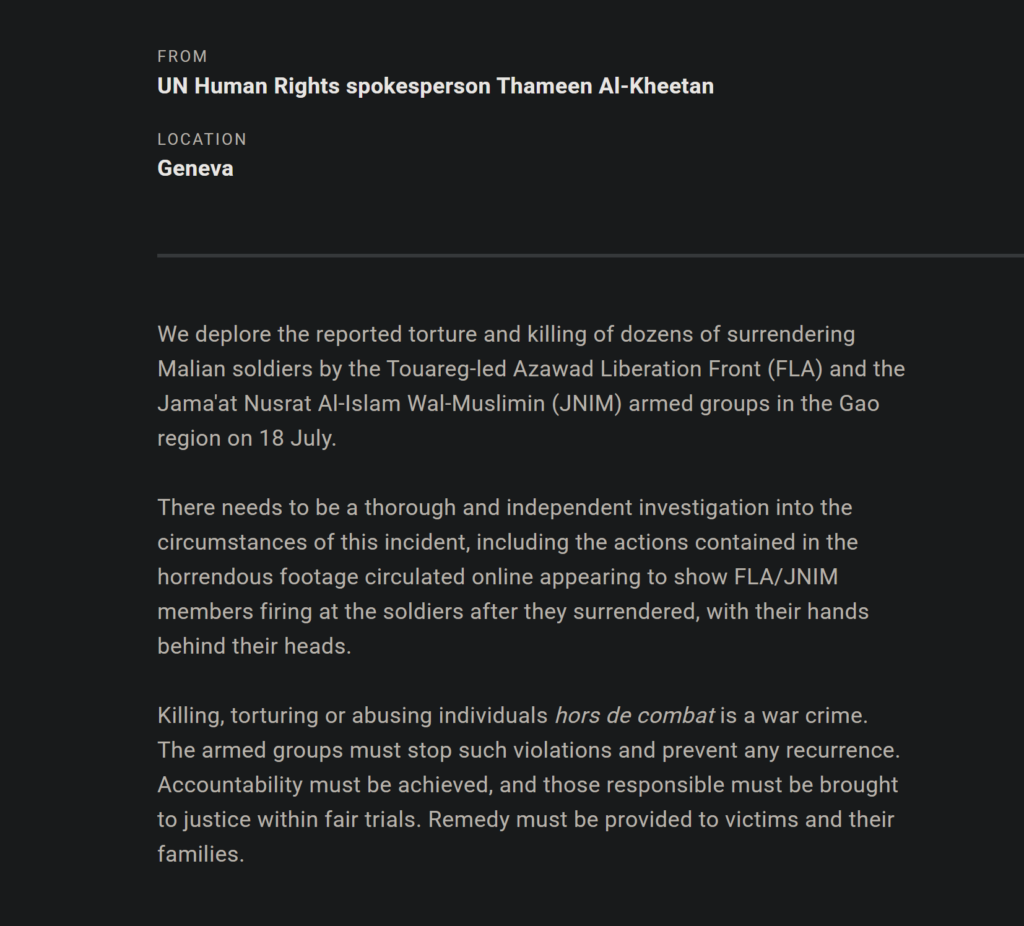
On 23 July 2026, the spokesperson for the UN High Commissioner for Human Rights, Thameen Al-Kheetan, issued a statement from Geneva on this incident. The Office deplored the reported torture and killing of dozens of surrendering Malian soldiers by the Touareg-led Azawad Liberation Front and Jama’at Nusrat al-Islam wal-Muslimin in the Gao region on 18 July, and demanded a thorough and independent investigation citing specifically the footage circulated online that appears to show members of the two groups firing on soldiers who had surrendered with their hands behind their heads. The Office stated the legal position in a single sentence: “Killing, torturing or abusing individuals hors de combat is a war crime.” It called on the armed groups to halt such violations and prevent recurrence, and for accountability through fair trials and remedy for victims and their families.
Read against this archive, the statement does three things. It names both organisations, jointly, as this documentation does. It adopts the precise legal characterisation hors de combat, war crime that this site applies to every case file it publishes. And it converts the footage in this article from atrocity content into the specified subject matter of a demanded international investigation. The characterisation is no longer only this archive’s. It is the United Nations’. The evidentiary preservation documented on this page is the direct, practical answer to the investigation the Office has called for.
OHCHR press release, 23 July 2026 The UN Human Rights Office statement of 23 July 2026, naming the FLA and JNIM and calling for a thorough and independent investigation.
jurisdiction, already open
At Baidoa, jurisdiction had to be stated honestly as contingent. Here it does not. Mali ratified the Rome Statute in August 2000, referred the situation on its own territory to the Office of the Prosecutor in July 2012, and the investigation opened in January 2013, covering crimes committed in Mali since January 2012, and still open. It has already produced two convictions: Ahmad Al Faqi Al Mahdi in 2016 and Al Hassan Ag Abdoul Aziz in 2024, both for crimes committed under the jihadist occupation of Timbuktu by Ansar Dine, the organisation that became the core of JNIM. The independent investigation the UN Human Rights Office has demanded does not need to be invented. It exists, and it has been running for thirteen years.
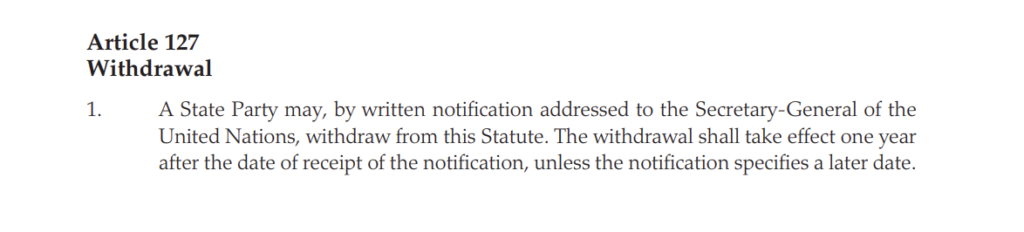
The timing must also be stated exactly, because it is now part of the story. On 24 June 2026, Mali deposited its formal notification of withdrawal from the Rome Statute with the UN Secretary-General, alongside Burkina Faso, Niger having done so on 18 June. Under Article 127, withdrawal takes effect one year after notification and it does not release a state from obligations incurred while it was a party, nor affect matters already under the Court’s consideration. The crimes documented in this article were committed on 18 July 2026, while Mali remained a State Party, inside an open investigation. The Court’s door is not closing on this incident. It is closing behind it. That is precisely why this record is preserved to evidentiary standard now.
precedent, the same charge against the same organisation
There is no need to reach for analogies. The ICC’s public arrest warrant against Iyad Ag Ghaly, founder of Ansar Dine and the current leader of JNIM charges him with war crimes including the murder of soldiers placed hors de combat at Aguelhoc, northern Mali, on 24 January 2012, where captured and incapacitated Malian soldiers were executed en masse. That warrant was issued under seal on 18 July 2017. It was unsealed on 21 June 2024. He remains at large.
The warrant was signed nine years to the day before Tabankort.
The man commanding this organisation is an ICC fugitive for precisely the category of crime his fighters filmed themselves committing on 18 July 2026, against the same army, on the territory of the same open investigation. Aguelhoc had to be reconstructed by investigators after the fact. Tabankort was filmed by its perpetrators and published within days. That evidentiary posture has precedent of its own: in August 2017 the Court issued its first arrest warrant grounded in social-media video, against Mahmoud al-Werfalli of Libya’s Al-Saiqa Brigade, charged with murder as a war crime under Article 8(2)(c)(i) on the basis of seven filmed execution incidents involving 33 victims, footage substantially produced and circulated by the brigade’s own media centre. A second warrant followed in 2018 after he filmed another. The perpetrating organisation published the evidence; the Court charged on it.
The ICC’s warrant against JNIM leader Iyad Ag Ghaly — issued under seal 18 July 2017, unsealed 21 June 2024 — includes the charge of murder of soldiers placed hors de combat at Aguelhoc.
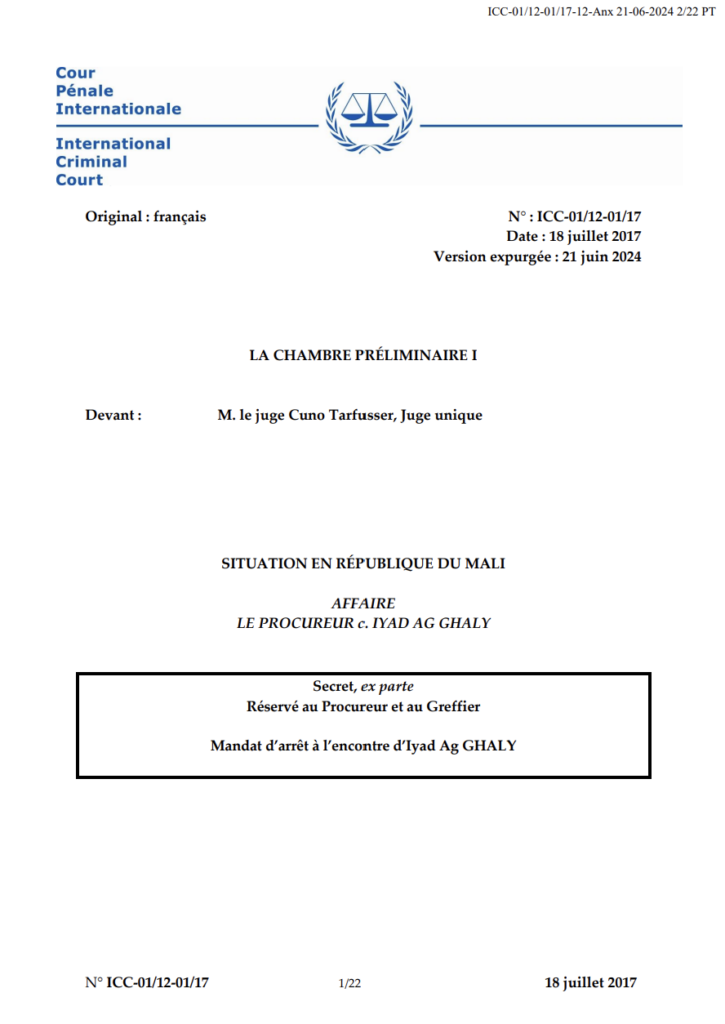
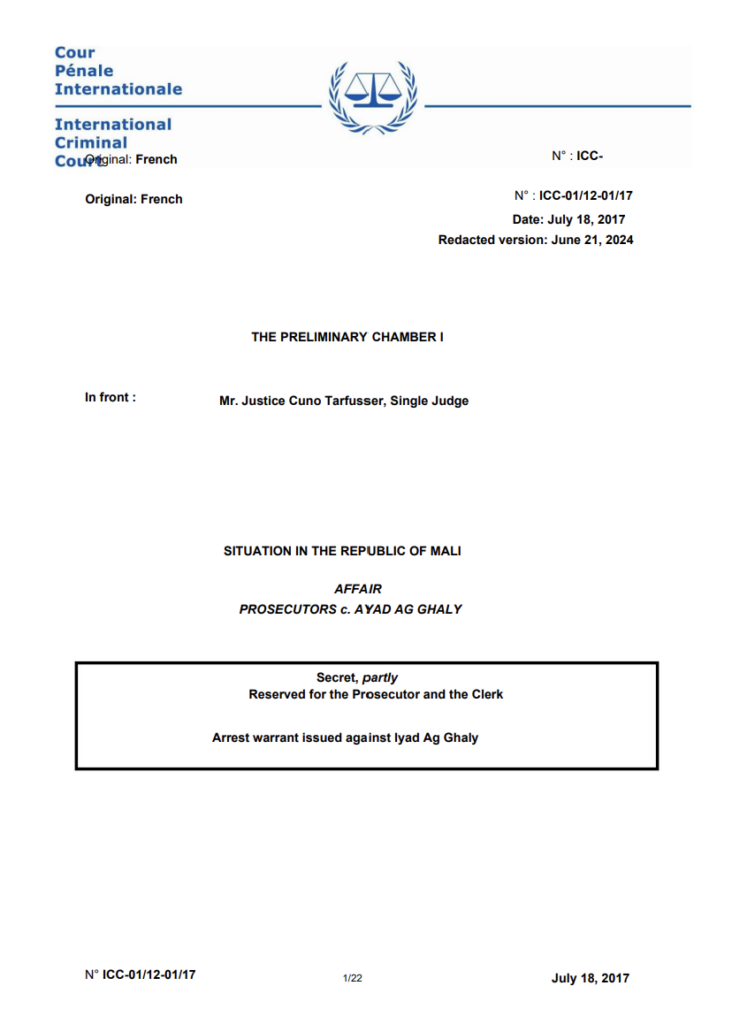
Iyad Ag Ghaly Arrest Warrant in full, it’s only in French.
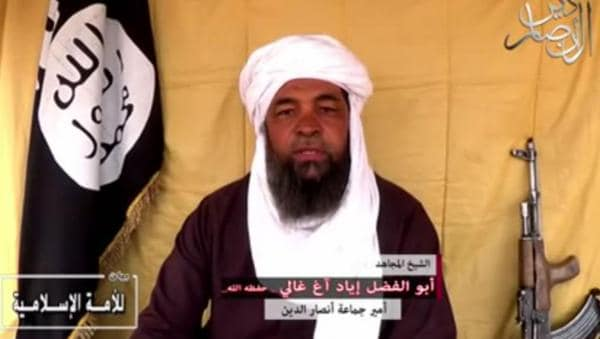
command responsibility
Article 28 of the Rome Statute extends liability to commanders and superiors who knew, or should have known, that forces under their effective control were committing such crimes and failed to prevent or punish them. Three facts bear on that standard here. First, this was not concealed conduct: it was filmed by cameras embedded at every phase, across the elements of two organisations operating in coordination, and distributed through organisational channels within days, the conduct of organisations documenting their practice, not hiding an excess. Second, JNIM’s most senior commander has been under a public ICC arrest warrant for the identical category of crime since June 2024; the organisation’s leadership is on formal, public notice that the mass execution of captured Malian soldiers is charged conduct, and whoever ordered, organised, filmed and published Tabankort did so inside that notice. Third, the conduct after the massacre, the publication, and then the managed release of burial footage once condemnation arrived, demonstrates continuing organisational control over both the ground and the narrative. The same exposure attaches to the FLA’s chain of command for its part in a jointly claimed operation. Failure to punish is an element of the doctrine, and the weeks ahead will document whether either organisation punishes anyone at all.
Islamic law, standing orders
Under Islamic law the conduct is condemned on its own terms not by inference or modern reinterpretation, but by the Prophet’s ﷺ standing instruction to every commander he appointed. Sahih Muslim, Book of Jihad and Expeditions (1731), preserves the campaign orders: fight in the name of Allah, do not steal from the booty, do not break treaties, do not mutilate, and do not kill children. The same instruction is carried in Bulugh al-Maram, Ibn Hajar al-‘Asqalani’s compilation of legal hadith (Book of Jihad, no. 1089 in the Darussalam edition), and Sahih al-Bukhari (2474) records the prohibition of mutilation alongside the prohibition of plunder. These are the operational orders of the tradition JNIM claims to fight for, addressed, specifically, to men leading fighters in the field.
Islamic law, the captive’s bond
The Qur’an legislates directly on the single most important fact in this footage: the bond. Surah Muhammad, 47:4, addresses the moment of victory, when the enemy is thoroughly subdued, “bind a bond firmly (on them): thereafter (is the time for) either generosity or ransom.” The verse that authorises the tying of a captive names exactly two ends for that bond: release by grace, or ransom. Execution is not in the verse. The fighters at Tabankort performed the first half of the ayah on camera, they bound their prisoners, and then did to them the thing the ayah does not permit. Surah Al-Insan, 76:8, counts feeding the captive among the marks of the righteous: the captive is fed and protected by the very party that holds him. Beyond the text, the classical jurisprudence of all four Sunni schools places the disposition of prisoners of war exclusively with legitimate authority, the imam or his delegate, deliberating case by case for the community’s interest, a consensus documented in Ahmed Al-Dawoody’s standard modern study of the classical sources. No school of Islamic jurisprudence delegates the fate of bound captives to the fighters holding them, and none permits what a firing line in the Tabankort desert did on 18 July. This archive stated that law in April, when JNIM or FLA fighters executed four captured FAMa soldiers. Three months later the same conduct was repeated at many times the scale.
Islamic law, war between Muslims
And the rule is stricter still in the only classical category actually available here, because the men who were bound and shot were Muslim soldiers of a Muslim army. In fighting between Muslims, classical fiqh, derived by Al-Shafi’i and others from the precedent of Ali ibn Abi Talib, holds that the fleeing are not pursued, the wounded are not finished, and the captured are not killed. The prisoner in intra-Muslim conflict is released, not executed; his life is protected by the same faith his captor claims. Whichever legal characterisation JNIM or the FLA assert for their war against Bamako, the execution of bound Muslim prisoners is haram within it.
Islamic law, the Maliki context
One more layer belongs in this analysis, because of where the killing happened. Mali’s Muslims overwhelmingly follow the Maliki school, and the Maliki tradition’s founding texts carry these prohibitions in their earliest strata. The Muwatta of Imam Malik preserves the first caliph Abu Bakr’s instructions to the armies of the early caliphate: do not kill women, children or the old; do not mutilate; do not destroy what sustains life. Ibn Abi Zayd al-Qayrawani’s Risala, the Maliki manual studied across West Africa for a thousand years, including in the mosques and schools of the very regions JNIM claims to defend, transmits the same law of restraint. JNIM presents itself as the protector of Mali’s Muslims and the implementer of sharia on their behalf. The sharia actually indigenous to Mali, the school of Timbuktu’s own scholars, prohibits every act in this record. The group did not merely violate international law near Tabankort. It violated the specific legal tradition of the population it claims to represent, in that population’s own homeland.
the seekers of a state
The FLA’s exposure has a different shape and deserves its own statement. The Azawad Liberation Front is not a jihadist project; it is a separatist movement that seeks recognition as the legitimate representative of a people and, ultimately, a state. Movements that seek statehood are judged on whether they conduct themselves as a state-in-waiting, and the law of armed conflict binds them identically in the meantime: Common Article 3, AP II and customary law admit no distinction between the jihadist and the nationalist wing of a joint operation. Both organisations claimed this attack in writing. The United Nations named both. And when the burial footage came, it came under Azawad’s name, the movement’s own units handling the dead its operation produced. A front that films the execution of bound prisoners, and then films itself burying them once the world objects, is not building the case for its statehood. It is building the case file against its command.
convergence
On the treatment of captives and of the dead, the two legal systems this archive works in do not merely overlap; they converge, a convergence documented by the ICRC’s own legal adviser on Islamic law, Ahmed Al-Dawoody, whose study concludes that the classical jurists’ rules on quarter, captivity and the dead correspond to the modern law’s core protections. A man who has laid down his arms is protected in both systems. A bound man is protected in both systems. The dead are owed decency in both systems. JNIM and the FLA did not fall short of a foreign standard near Tabankort. They fell short of both systems at once, and of the older one first.
the families
Videos 25 through 28 close this record at the other end of the propaganda pipeline: wives, mothers and relatives of the killed, recorded in grief in the days after the massacre, in videos the families themselves made public. They are included here for two reasons, and spectacle is not one of them. They corroborate: the deaths announced by the perpetrators’ cameras are registered independently, in Malian homes, by the people to whom these men were not soldiers but husbands and sons, a second, independent evidentiary leg, and where a family names its dead, that name enters the verification record by the same standard this archive applied to the named commanders at Baidoa. And they are the ledger of what a casualty figure means. The perpetrators built a record designed to end at the bodies in the sand. The record does not end there. It ends in the homes these men did not return to. Grief, too, is evidence.
Videos 25–28 — family members of the killed, in videos they made public in the days after the massacre.
a documented pattern
Tabankort is not an aberration; it is an escalation along a line this archive has been tracking all year. In April 2026, JNIM insurgents were filmed tormenting and executing a wounded Burkinabe soldier a single hors de combat killing. The same month, JNIM or FLA fighters captured and individually executed four FAMa soldiers in northern Mali, and in Kidal a captured combatant was executed and publicly displayed. In May, Al-Shabaab filmed hors de combat killings and corpse mutilation near Baidoa the same doctrine of the camera in a different theatre. And behind all of it stands Aguelhoc, January 2012, where the mass execution of captured Malian soldiers produced the charge that sits in the ICC’s warrant against JNIM’s current leader. From one captive, to four, to the dozens documented on this page, filmed each time, published each time, by organisations that have learned there is no cost. The trajectory from April to July 2026 is not a series of excesses. It is a practice, consolidating. That is the finding of this article, and it is the finding that most warrants professional attention: the execution of prisoners is becoming a normalised, filmed, institutional output of the JNIM–FLA campaign in northern Mali. The United Nations has now said, of this incident, what this archive has said of each one before it. The question the pattern poses is whether anything follows.
the archive
Every video and photograph in this release, in archive order, for evidentiary completeness. Edited versions carry this site’s standard treatment; unedited originals are preserved under hash verification and are not published.
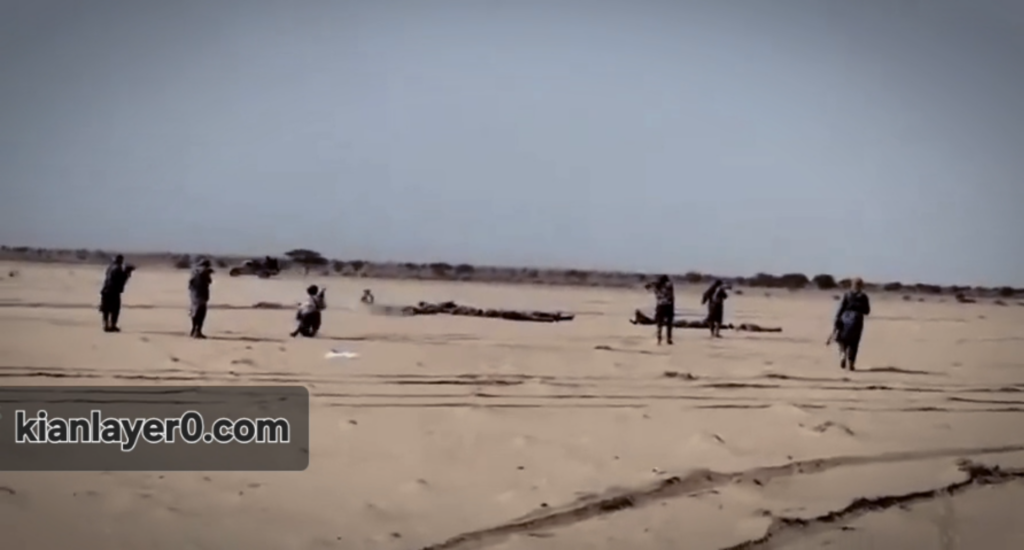
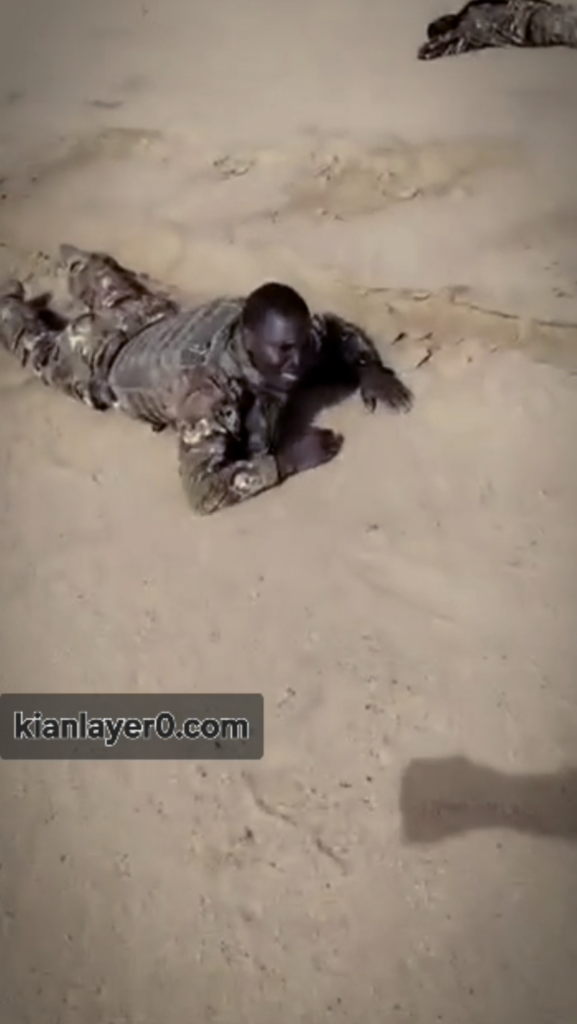
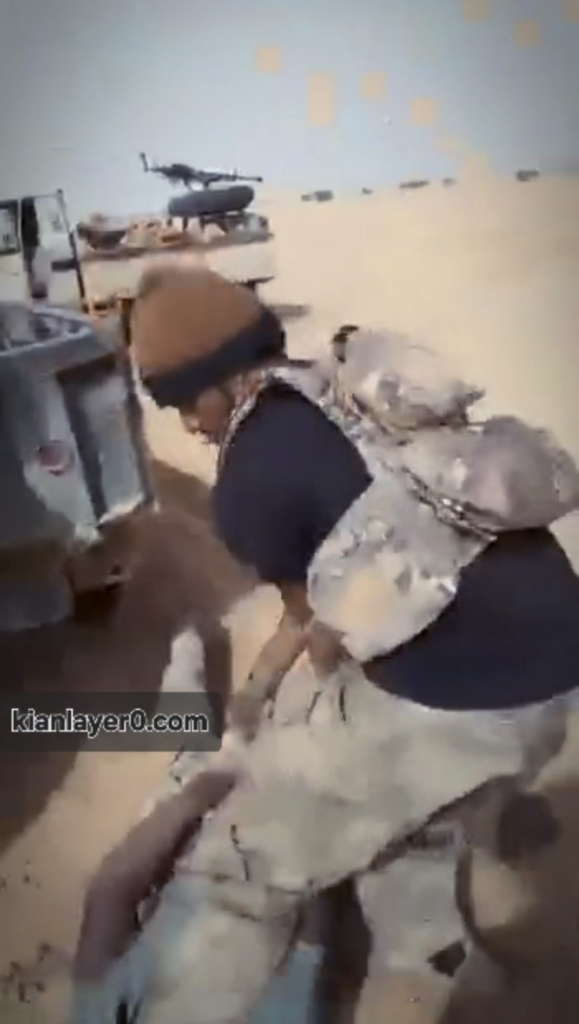
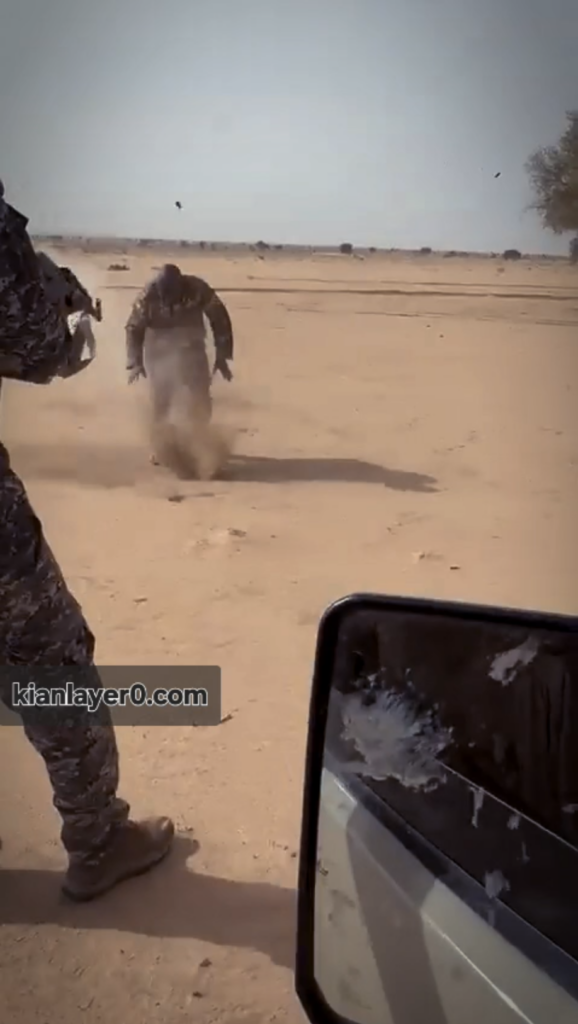
Photographs and screenshots consistent with the sequence of events laid out in this timeline, a small fraction of what is available but enough to corroborate the sequence from the video footage in the short time available before this publication.
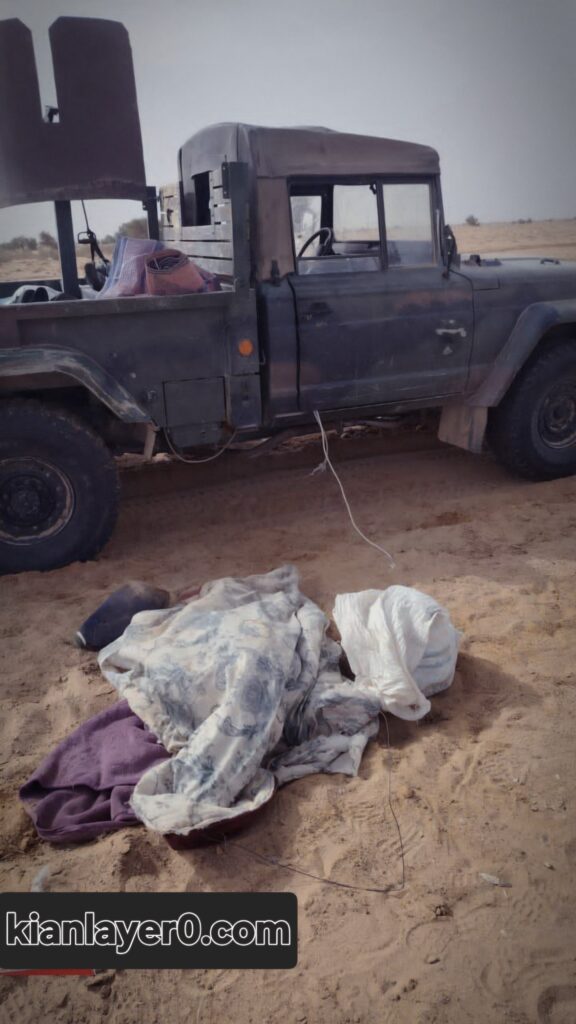
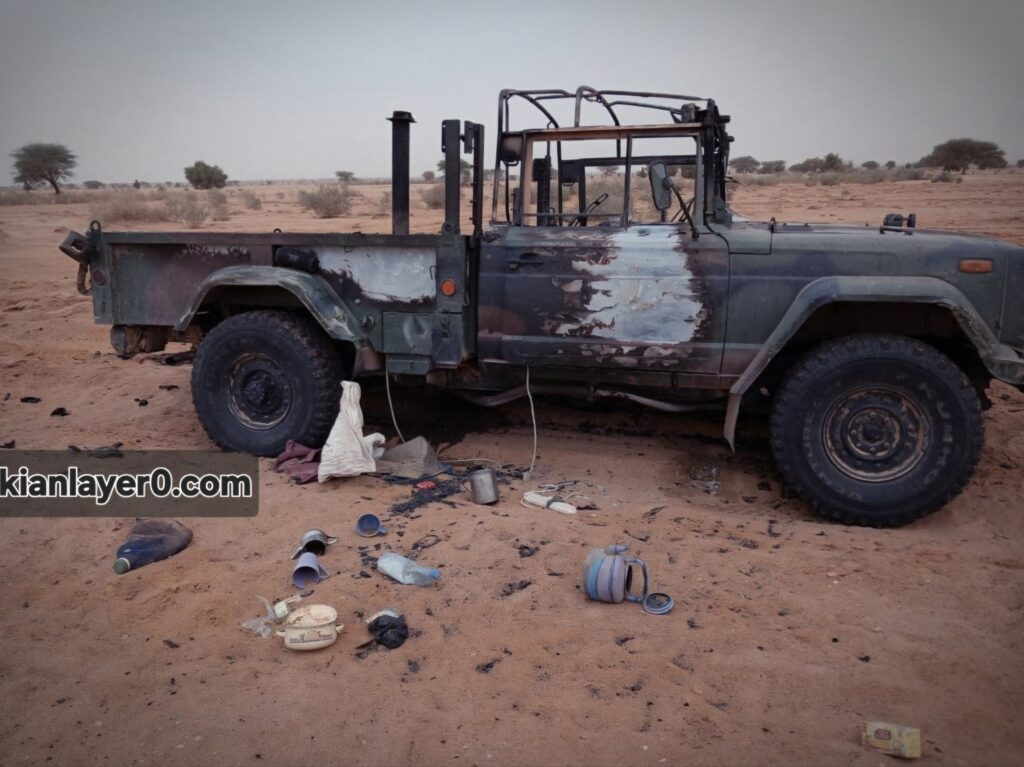
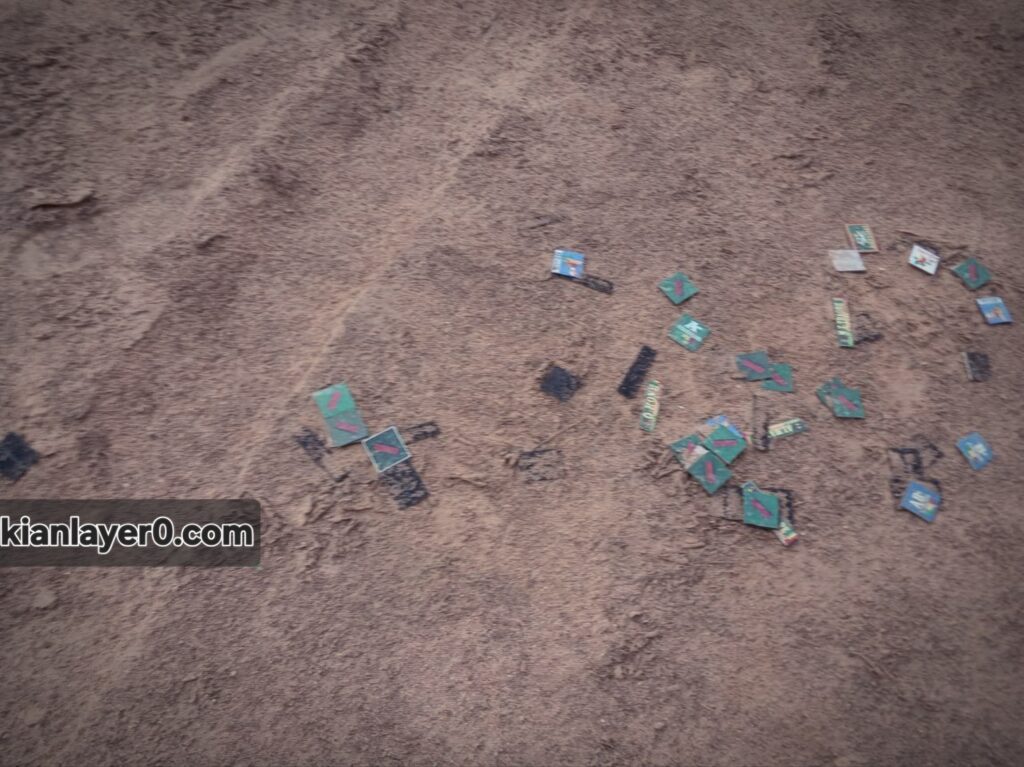
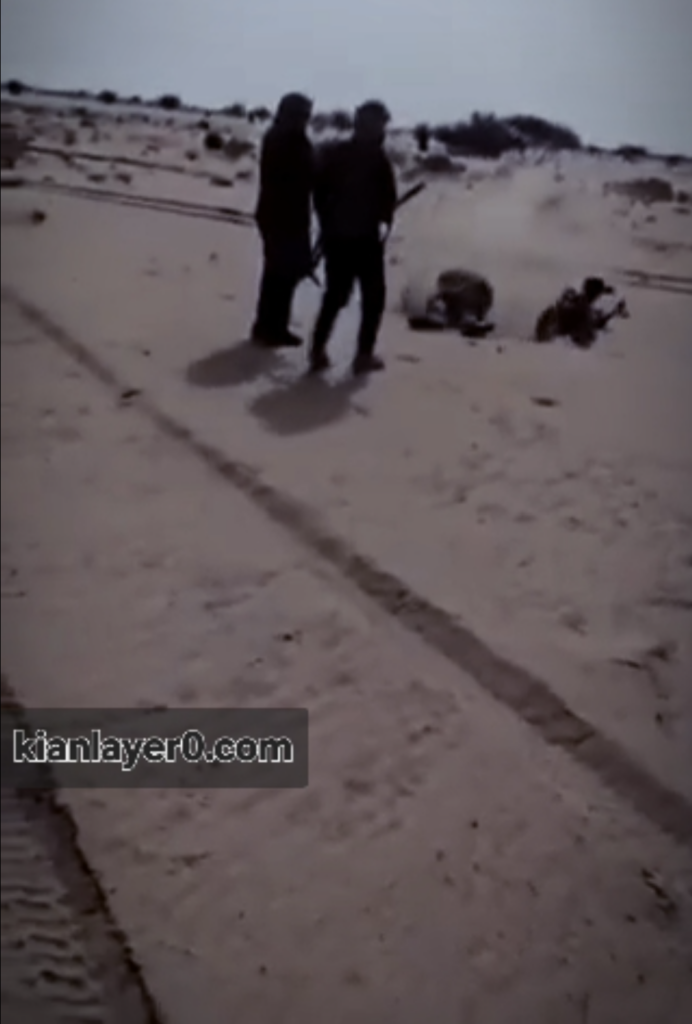
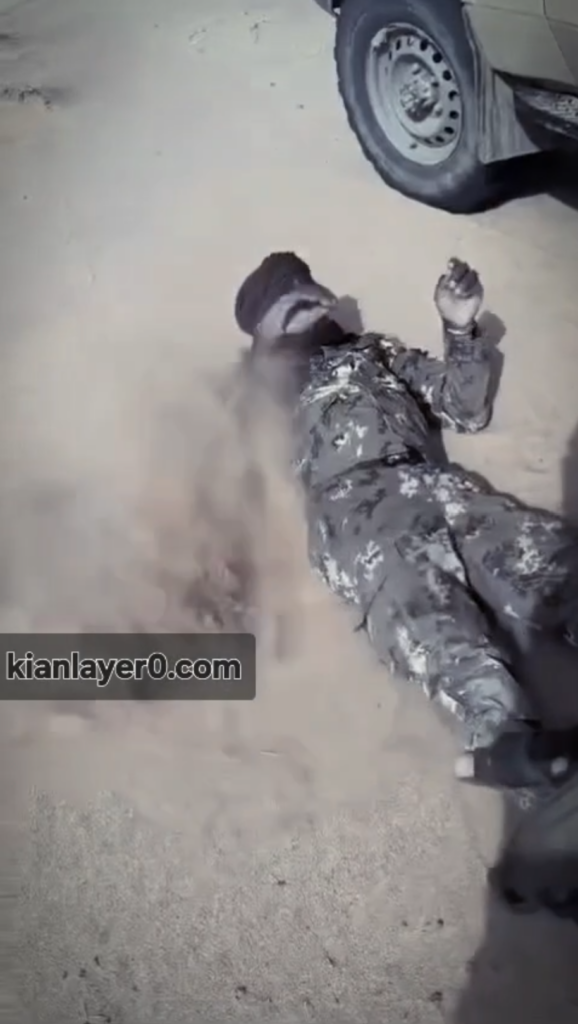
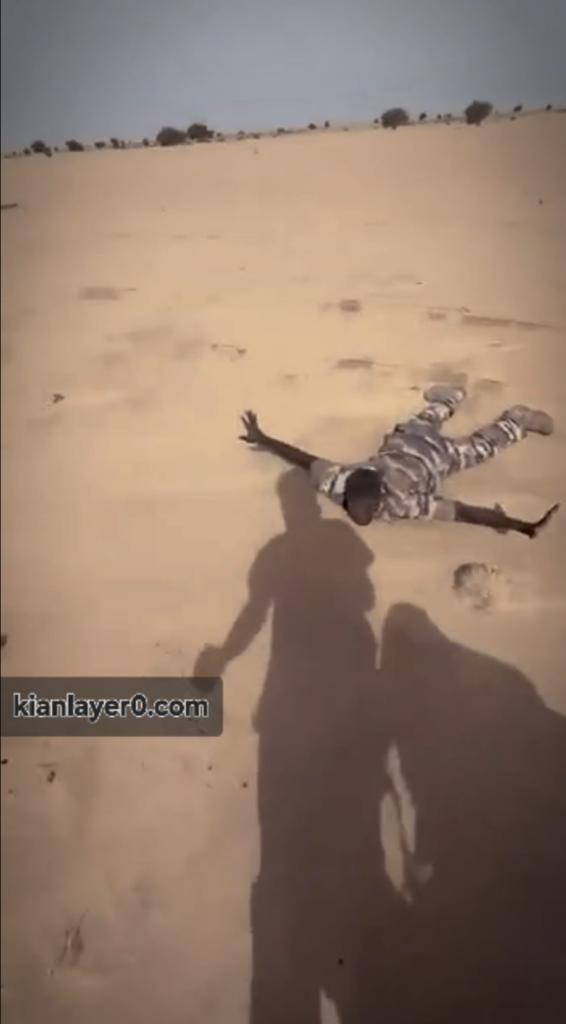
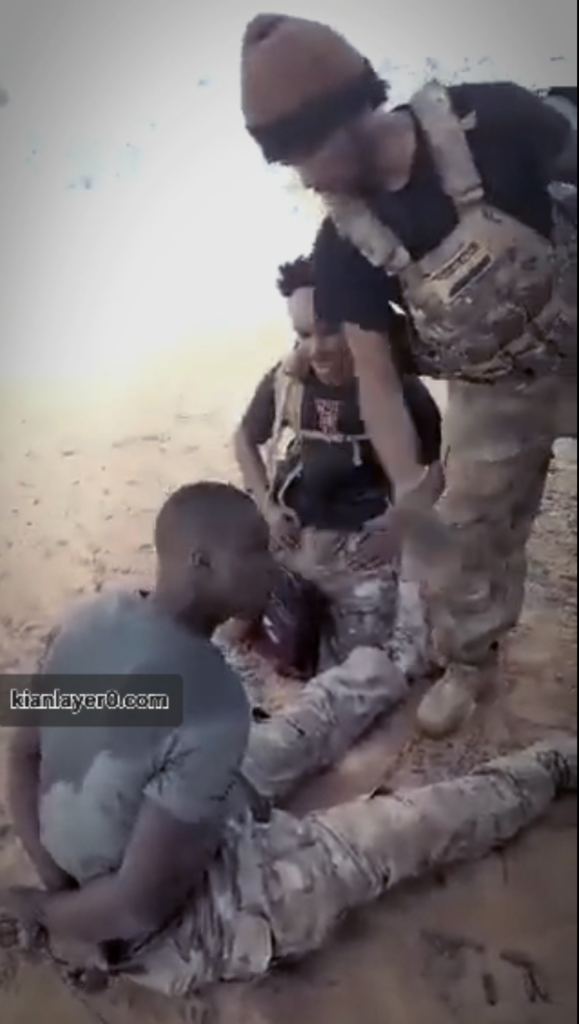
source credibility
Source credibility assessed as high on the core facts, which now rest on four independent legs. First, the footage is self-published by the perpetrating organisations through their affiliated channels, and both organisations claimed the operation in writing on the day. Second, the incident is confirmed by the Malian army’s own statements of 18 and 19 July and by contemporaneous wire reporting (AFP, AP) describing the same footage, soldiers surrendering in lines, prisoners transported in the groups’ vehicles, men shot on the ground. Third, on 23 July the UN Human Rights Office publicly named both groups, characterised the toll as dozens of surrendering soldiers reported tortured and killed, described the footage of men shot after surrendering with hands behind their heads, and demanded a thorough and independent investigation. Fourth, the deaths are registered from the victims’ side, in the public grief of their families. Casualty totals beyond footage-derived minimums are presented as claimed or assessed, and graded as such in the text. Chronology: ambush on the morning of 18 July 2026; perpetrator footage circulated from 18 July, described in AFP and AP reporting on 18 and 19 July; UN statement 23 July; burial footage circulated in the days following. Per-clip first-seen dates and file-metadata cross-checks are held in the evidentiary record and available on verified request. Original footage preserved unedited with SHA-256 hash verification and chain-of-custody records to Berkeley Protocol standard; available to the ICC, OHCHR, UN accountability mechanisms, or credentialed researchers upon verified request. Mali’s withdrawal from the Rome Statute takes effect in late June 2027. These crimes were committed inside the Court’s jurisdiction, and this record is preserved to the standard that jurisdiction deserves.
kianlayer0 (Kian Tveitan) OSINT conflict reporter documenting war crimes in East Africa and the Sahel to international evidentiary standards.